
Pyrite, often called Fool’s Gold, shimmers with a golden gleam that has tricked many hopeful prospectors throughout history. This amazing mineral forms when iron and sulfur combine in nature, creating beautiful cubic crystals that catch the light.
You can find pyrite in thousands of places across the world, with major deposits in Spain, Italy, and numerous locations throughout the United States including Colorado, Illinois, Arizona, and Pennsylvania. Many mines and mineral districts offer great chances to discover your own specimens of this fascinating mineral.
Your best bet for finding pyrite is to look in areas with a history of mining activity. Places like Utah’s Salt Lake County and Tooele County have lots of pyrite in their old mining districts. Even better, many of these sites welcome rock collectors who want to search for their own pieces of this sparkly treasure.
Pyrite’s Geological Significance
Pyrite plays a big role in the study of rocks and minerals. Its bright brass-yellow color and distinctive crystal shapes make it easy to spot in many different rock types.
Mineral Classification
Pyrite belongs to the sulfide group of minerals. Its chemical formula is FeS2, which means it contains iron and sulfur. You can find it in all three main rock types: igneous, metamorphic, and sedimentary.
Pyrite forms in many different settings, from deep underground to near the Earth’s surface. It often shows up where there’s little oxygen, like in coal deposits or muddy ocean floors.
This mineral is the most common sulfide on Earth. You’ll often see it mixed with valuable minerals like gold and copper.
Crystal Structure and Physical Properties
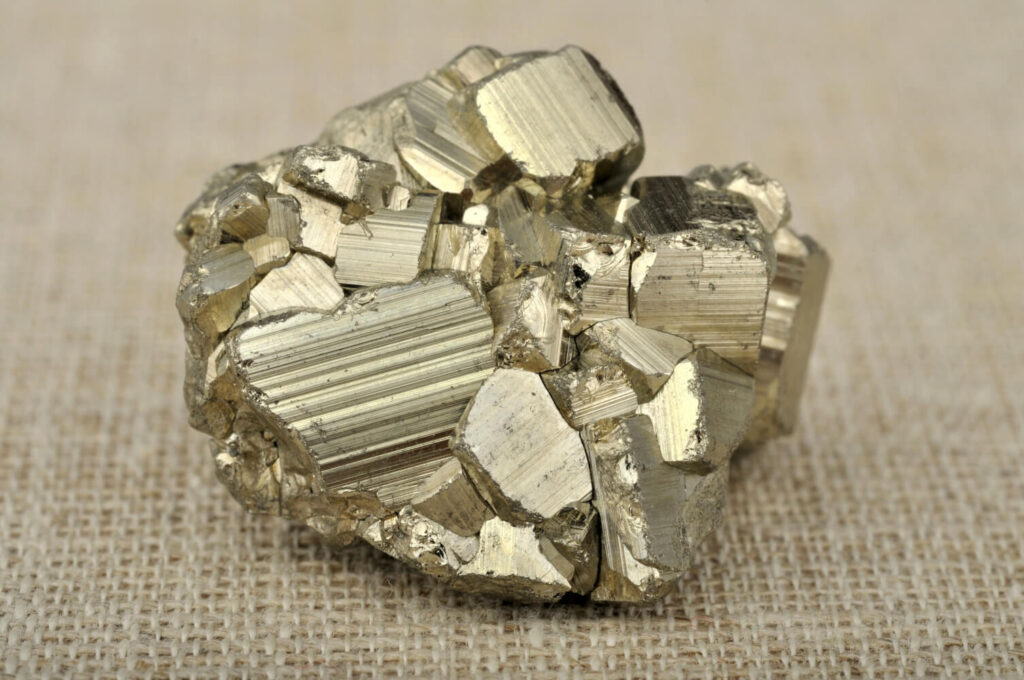
Pyrite forms perfect cubic crystals with smooth, shiny faces. Sometimes you’ll spot it in eight-sided shapes called octahedrons.
The mineral ranks 6-6.5 on the hardness scale, making it pretty tough. You can test it by trying to scratch it with a nail – pyrite won’t scratch easily.
Its specific gravity is 5, which means it’s about five times heavier than water. That’s why pyrite feels surprisingly heavy when you pick it up.
The crystal structure gives pyrite its famous metallic shine. When light hits its surface, it reflects back with a golden gleam that once fooled many gold seekers.
Worldwide Locations and Mining Areas
Pyrite deposits exist across every continent in various geological settings like sedimentary rocks, hydrothermal veins, and metamorphic formations. You can find both small crystal specimens and massive mining deposits suited for commercial extraction.
Pyrite Deposits in the Americas
You’ll discover rich pyrite deposits throughout North and South America. Peru hosts some of the world’s largest pyrite mines, especially in its mountainous regions.
In the United States, several states offer excellent pyrite hunting grounds:
- Colorado: Multiple mining districts with pyrite veins
- Illinois: Sedimentary deposits mixed with coal seams
- Arizona: Copper mines often containing pyrite crystals
- Missouri: Lead and zinc mines with pyrite formations
- Montana: Historical mining areas with accessible specimens
Many old mining claims in these regions still yield quality specimens. You can often collect samples from mine tailings or exposed rock faces.
European Pyrite Sources
Spain leads European pyrite production with its famous Rio Tinto mines. These ancient workings date back to Roman times.
La Rioja in northern Spain features numerous pyrite deposits within its mountainous terrain. You can find specimens ranging from tiny cubic crystals to massive formations.
Notable European Locations:
- Spain’s Andalusia region
- Italian Alpine deposits
- Norwegian fjord formations
- German Black Forest mines
Other Global Pyrite Localities
Australian outback mines yield significant pyrite deposits alongside other minerals. You’ll find notable formations in Western Australia’s gold mining regions.
China’s pyrite mines rank among the world’s largest producers. Major deposits exist in:
- Yunnan Province
- Guangxi Region
- Inner Mongolia
South African gold mines frequently contain pyrite in their ore bodies. These deposits often appear alongside other sulfide minerals.
Pyrite in Different Rock Types
Pyrite shows up naturally in many types of rocks, adding golden sparkles to the stone. You can find these shiny crystals scattered through different rock layers and formations across the globe.
Sedimentary Rock Occurrences
Pyrite loves to form in sedimentary rocks, especially in places rich in organic matter. You’ll often spot it in coal beds, where the mineral creates bright metallic streaks.
In limestone and shale deposits, pyrite forms neat cubic crystals that catch your eye against the darker rock.
The mineral also appears in sandstone formations, sometimes replacing plant fossils or creating interesting shapes called concretions.
Pyrite in Metamorphic Rocks
When you explore metamorphic rocks, you might find pyrite mixed with other shiny minerals. It’s common in schist and gneiss, where heat and pressure have helped create perfect crystal shapes.
The pyrite crystals in slate often line up in neat rows due to the rock’s formation process.
You can spot pyrite clusters in marble too, where they stand out against the white or gray stone.
Pyrite and Igneous Formations
In igneous rocks, pyrite often shows up in veins with quartz and calcite. These veins form when hot fluids move through cracks in the rock.
You’ll find pyrite scattered through granite and other igneous rocks, where it formed as the molten rock cooled.
Look for pyrite near volcanic areas too – it often forms in the spaces between lava flows or in the cracks of cooled volcanic rock.
The Many Faces of Pyrite
Pyrite forms distinct crystal shapes and habits that make it one of the most visually interesting minerals you’ll encounter. Each crystal face can take on unique patterns and appearances.
Variations in Crystal Habit
You’ll find pyrite growing in several different ways. When conditions are right, pyrite forms as single, well-shaped crystals with smooth, shiny faces.
Some pyrite grows in masses where many small crystals cluster together, creating a drusy coating that sparkles like tiny mirrors.
Pyrite also forms twins, where two crystals join together in specific patterns. These twinned crystals often show striations – fine parallel lines across their faces.
Distinct Pyrite Crystal Forms
The most common shape you’ll see is cubic pyrite, with six square faces at right angles to each other. These cubes can range from tiny specks to impressive specimens several inches across.
Pyritohedral pyrite has twelve five-sided faces, creating a more complex shape than simple cubes. This form is less common but still regularly found.
Octahedral pyrite shows eight triangular faces. You’ll find these crystals less often than cubic forms, making them prized by collectors.
The faces of pyrite crystals often show natural striations. These lines cross at 90-degree angles on cubic crystals, creating distinctive patterns you can use to identify the mineral.
Identifying Pyrite
Pyrite has unique physical traits that make it easy to identify in nature with a few simple tests and observations. Its distinct brass-yellow color and metallic shine set it apart from other minerals.
Physical Identification Tips
Pyrite has a bright, brassy-yellow color that catches the eye. When you spot a fresh surface, you’ll notice its metallic shine that sparkles in the sunlight.
The mineral ranks at 6-6.5 on the Mohs hardness scale. You can test this by trying to scratch it with a steel nail – pyrite will resist scratching.
Pyrite forms perfect cubic crystals and sometimes appears as octahedrons. You might also find it in massive chunks or tiny grains embedded in rock.
A streak test will reveal pyrite’s true nature. Scratch it on a white ceramic tile and you’ll see a greenish-black streak.
Pyrite vs. Marcasite
Pyrite and marcasite share the same chemical formula (FeS2), but their crystal structures differ. Pyrite forms cubic crystals, while marcasite creates spear-shaped ones.
Marcasite has a paler color than pyrite, appearing more whitish-yellow. It’s also more brittle and breaks down faster when exposed to air.
You can tell them apart by their crystal habits. Look for pyrite’s neat cubes or octahedrons versus marcasite’s blade-like or cockscomb formations.
Common Confusions With Gold
Despite its nickname “Fool’s Gold,” pyrite looks quite different from real gold. Gold is softer – you can scratch it with a copper penny, but pyrite won’t scratch.
Gold has a warm yellow color, while pyrite shows a brassy, metallic shine. Gold bends easily, but pyrite breaks into sharp pieces.
Try the streak test – gold leaves a yellow streak, while pyrite’s streak is greenish-black.
Gold nuggets are usually rounded and smooth. Pyrite typically forms angular crystals with flat faces.
Pyrite’s Interaction With Other Elements
Pyrite forms strong chemical bonds with sulfur and interacts with various metals in nature. These interactions make it a key player in both mineral formation and mining operations.
Pyrite and Sulfide Minerals
Pyrite is the most common sulfide mineral you’ll find in the Earth’s crust. Its chemical formula FeS2 shows it’s an iron disulfide, meaning each iron atom bonds with two sulfur atoms.
When exposed to oxygen and water, pyrite can break down to form sulfuric acid. This process happens naturally in mines and can affect water quality.
You’ll often find pyrite growing alongside other sulfide minerals like sphalerite, chalcopyrite, and galena. These minerals share similar formation conditions and chemical properties.
Pyrite’s Role in Ore Genesis
Pyrite typically forms in hydrothermal veins where hot, mineral-rich fluids move through rock cracks. These veins often contain valuable metals and minerals.
You can spot pyrite’s distinctive cubic crystals in many ore deposits. Its isometric crystal structure lets it grow into perfect cubes.
Pyrite acts as an indicator mineral for gold deposits. Where you find pyrite, you might find gold – though don’t get too excited, as pyrite is much more common!
Many valuable ore deposits contain pyrite mixed with copper, zinc, and lead minerals. Mining companies use this relationship to help find new mineral deposits.
Economic and Industrial Uses of Pyrite
Pyrite has become a valuable mineral in both decorative and technological applications, making it much more than just a pretty rock.
Pyrite in the Jewelry Industry
Your jewelry box might already contain some pyrite pieces. Its metallic, gold-like shine makes it popular in fashion jewelry and decorative items.
Crafters often shape pyrite into beads, pendants, and ring settings. The mineral’s natural crystal formations create eye-catching geometric patterns.
You can find pyrite used in both modern and vintage-style pieces. Its durability and affordability make it a smart choice for everyday wear.
Pyrite’s Use in Modern Technology
Pyrite helps power green technology in exciting ways. Its high sulfur content makes it useful in developing new types of rechargeable batteries.
You’ll find pyrite working behind the scenes in semiconductor manufacturing. Its unique properties help create electronic components.
Modern industries use pyrite to make sulfuric acid, which is key in making fertilizers and other products you use daily.
Scientists are testing pyrite in solar cells too. Its properties could help make solar power more affordable and efficient for your home.
Environmental Impact and Concerns
Pyrite mining and exposure can create serious challenges for nearby water sources and ecosystems. These effects need careful management to protect the environment.
Acid Mine Drainage Issues
When pyrite comes in contact with water and air, it creates sulfuric acid and iron sulfate through a chemical reaction. This process is called acid mine drainage.
Your local water sources can become very acidic when mining operations expose large amounts of pyrite to the elements. The acidic water often takes on a rusty orange color due to the dissolved iron.
Fish and other aquatic life can’t survive in these acidic conditions. The contaminated water may also seep into groundwater supplies used for drinking.
Ecosystem Recovery Processes
Natural environments usually handle small amounts of exposed pyrite without problems. The surrounding soil and rock help neutralize any acid that forms.
You can help damaged areas recover through several methods. Adding limestone helps neutralize acidic soil and water. Native plants that tolerate acidic conditions can also help stabilize the soil.
Water treatment systems can remove harmful metals and reduce acidity before mine drainage reaches streams or rivers. With proper care and time, affected ecosystems can slowly heal and support life again.
Regular monitoring helps track recovery progress and catches new problems early. This lets you adjust treatment methods as needed.
Recreational Collecting and Ornamental Use
Pyrite makes an exciting target for rock collectors and looks stunning in mineral displays. Its metallic shine and crystal patterns catch the eye and spark interest in geology.
Rockhounding for Pyrite
You’ll find pyrite in many places across the United States. Salt Lake County and Tooele County in Utah offer great spots to start your search, with many old mining areas still rich in specimens.
Look for pyrite in black shales and limestone formations. The cubic crystals often stand out against darker rocks with their brass-yellow color.
Bring proper tools like a rock hammer, safety glasses, and sturdy gloves. Make sure you have permission to collect at your chosen site.
Displaying Pyrite Specimens
Clean your pyrite specimens gently with a soft brush to keep their shine. Display them in clear cases or on shelves where light can highlight their metallic sparkle.
Keep your pyrite away from humid areas, as moisture can cause it to break down over time. Small display boxes with silica gel packets help protect your specimens.
Tip: Group similar crystal shapes together to create eye-catching arrangements. Cubic forms make especially striking displays when gathered as a collection.
Label your specimens with their collection location and date. This adds value to your collection and helps you share their stories with others.
Beyond Earth: Pyrite in Extraterrestrial Geology
Space rocks and distant planets hold fascinating secrets about pyrite formation beyond our planet. Scientists have discovered this shiny mineral in meteorites and use it as a clue to understand life’s potential in space.
Pyrite in Meteorites
You can find pyrite crystals in several types of meteorites, especially in iron meteorites and chondrites. These space-born pyrite formations are often tiny – smaller than a grain of sand.
The mineral forms differently in space than on Earth. Zero gravity creates unique crystal shapes and growth patterns that scientists can study to learn about space conditions.
Some meteorite pyrite shows signs of forming in the presence of water, which teaches us about ancient space environments. Your chances of finding pyrite in a meteorite are highest in specimens from asteroid belts.
Astrobiological Implications of Pyrite
Pyrite plays a special role in the search for space life. Your understanding of life’s origins gets clearer when you study this mineral.
The mineral can help create organic compounds needed for life. Scientists have shown that pyrite surfaces can concentrate and organize basic molecules.
Space missions look for pyrite deposits on Mars and other planets. When you find pyrite, it often means water was once present – a key ingredient for life.
Pyrite’s paramagnetic properties make it easier to detect from orbit. You can spot large deposits using special magnetic sensors on space probes.