

Crystal pendulums are fascinating tools that tap into your own energy and intuition. They work through subtle movements that reflect your inner knowing, making them perfect for getting clear answers to your questions.
Your pendulum moves because of small, unconscious muscle movements in your hand and arm, which are influenced by your intuition and energy field. The crystal amplifies these tiny movements, making them visible as the pendulum swings in different patterns.
You might wonder if it’s just random motion, but pendulum movements become consistent when you tune into your energy. The crystal’s natural properties help strengthen the connection between your conscious and subconscious mind, allowing clearer communication through the pendulum’s swings.
Understanding Crystal Pendulums
Crystal pendulums let you tap into your intuition through a simple weighted crystal hanging from a chain or string. These tools work by responding to subtle energy movements and your subconscious mind.
History and Usage
Crystal pendulums have roots in ancient divination practices across many cultures. Early civilizations used them to find water sources and minerals underground.
Healers and mystics adopted pendulums for energy work and answering questions. They would hold the pendulum still and watch which direction it moved.
The practice spread worldwide through trade routes. Different regions developed their own methods and meanings for pendulum movements.
Types of Crystals
Popular Crystal Choices:
- Clear quartz for general purpose and clarity
- Amethyst for spiritual connection
- Rose quartz for emotional healing
- Citrine for decision making
- Black tourmaline for protection
Each crystal type brings unique properties to pendulum work. Pick a crystal that matches your goals and feels right to you.
The crystal’s natural structure affects how it moves and responds to energy. Clearer crystals tend to give sharper movements.
Shapes and Sizes
Crystal pendulums come in many shapes:
- Pointed tip for precise answers
- Rounded for gentle energy work
- Faceted for amplified energy
- Smooth for balanced responses
The weight affects how the pendulum swings. Lighter ones move quickly while heavier ones give slower, steadier responses.
Your hand size and comfort level matter when picking a size. Most pendulums are 1-3 inches long, plus the chain length.
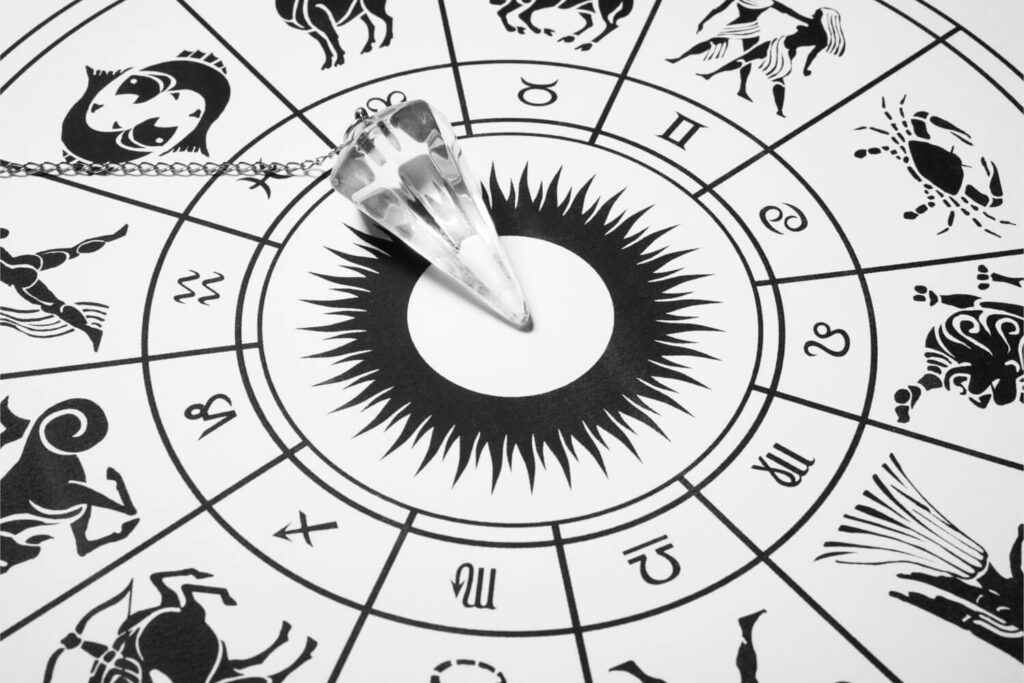
The Science Behind Pendulum Movement
Pendulums follow basic laws of physics that create their distinct swinging motion through the interplay of gravity and inertia. The energy that moves through a pendulum transforms between potential and kinetic states.
Physics of Pendulums
When you pull a pendulum to one side, you give it potential energy. As soon as you let go, gravity pulls the weight (called a bob) downward. The bob speeds up as it swings toward the center point.
The pendulum’s inertia causes it to keep moving past the center. It swings up on the other side until gravity stops its upward motion. Then the cycle starts again in the opposite direction.
The length of the pendulum wire or string affects how fast it swings. A longer pendulum swings more slowly, while a shorter one moves more quickly.
Energy Interactions
Your pendulum converts energy back and forth between two main types. At the highest points of the swing, it has maximum potential energy. At the center point, it reaches maximum kinetic energy.
Air resistance and friction gradually reduce the pendulum’s energy. This makes each swing slightly smaller than the last one. Without these forces, your pendulum would swing forever.
The pendulum’s movement creates a steady rhythm. Each complete swing takes the same amount of time, as long as the length stays constant. Scientists call this regular timing “simple harmonic motion.”
Using Crystal Pendulums
Crystal pendulums help you tap into your inner wisdom and connect with subtle energies. They serve as tools for personal guidance, energy work, and finding answers to questions.
Purposes and Intentions
Crystal pendulums work best when you set clear intentions before use. Hold your pendulum in your dominant hand, letting it hang freely from the chain or cord.
Start by establishing your “yes” and “no” signals. Ask your pendulum to show you what each response looks like. Common movements include:
- Back and forth (like nodding)
- Side to side
- Clockwise circles
- Counterclockwise circles
Write down these movements in a journal to remember your pendulum’s unique language.
Cleansing and Charging
Clean your pendulum regularly to maintain its energy connection. Smudge it with sage smoke or place it in sunlight for 1-2 hours.
You can also cleanse your pendulum by:
- Placing it on a selenite charging plate
- Running it under cool water
- Burying it in sea salt overnight
Program your pendulum with your energy by holding it close to your heart for a few minutes. State your intentions clearly.
Reading Techniques
Start with simple yes/no questions. Hold the pendulum steady and focus on your question.
Keep your arm still and rest your elbow on a table for stability. Let the pendulum move naturally without forcing it.
For deeper insights, create a pendulum chart with multiple options. Draw a circle and divide it into sections with different answers.
Try scanning your body’s energy centers by holding the pendulum over each chakra point. Notice the direction and intensity of movement.
Take breaks between readings to maintain accuracy. Trust your intuition if something feels off.

Interpreting Pendulum Responses
A crystal pendulum communicates through distinct movement patterns that carry specific meanings. The key is learning to read these patterns and maintain the right conditions for accurate readings.
Understanding Yes, No, and Maybe
Start by setting your pendulum’s directional meaning. Hold it steady and ask it to show you “yes” – note the movement pattern. It might swing front-to-back, side-to-side, or in circles.
Ask for “no” next and watch the pattern. It will typically move in a different direction than your “yes” response.
For “maybe” or “unclear,” the pendulum might show weak movement or swing chaotically. Make a note of these patterns in a journal until you can recognize them easily.
Factors Affecting Accuracy
Your physical state plays a big role in reading accuracy. Being tired or stressed can lead to unclear responses.
Create a quiet space away from distractions. Turn off your phone and find a comfortable seat where you can focus fully on your pendulum.
Your emotional state matters too. Stay neutral about the questions you ask. Strong hopes or fears about specific answers can affect the pendulum’s movement.
Tips for Better Readings:
- Take deep breaths before starting
- Keep your hand steady
- Ask clear, specific questions
- Practice regularly to build confidence