
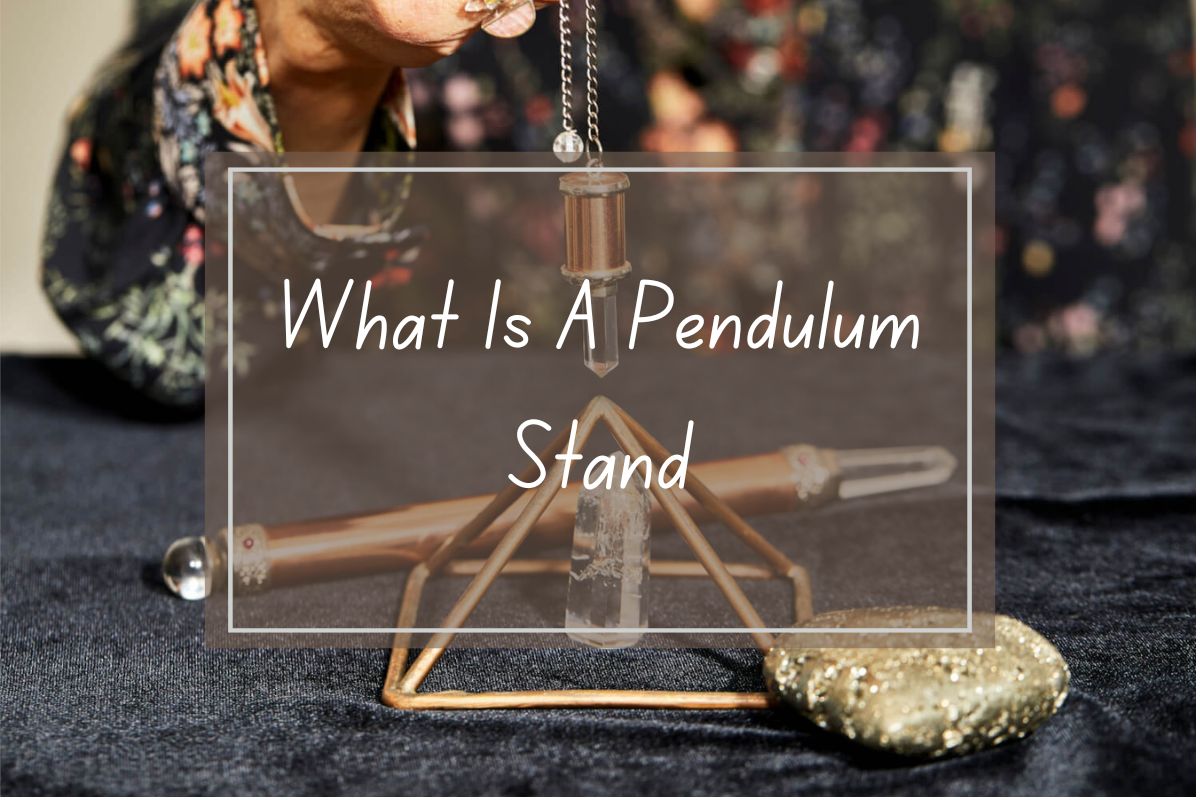
A pendulum stand is more than just a simple display piece – it’s a practical tool that keeps your pendulums safe and ready for use. Whether you use pendulums for divination, meditation, or decoration, having a proper stand prevents tangling and damage while making them easy to access.
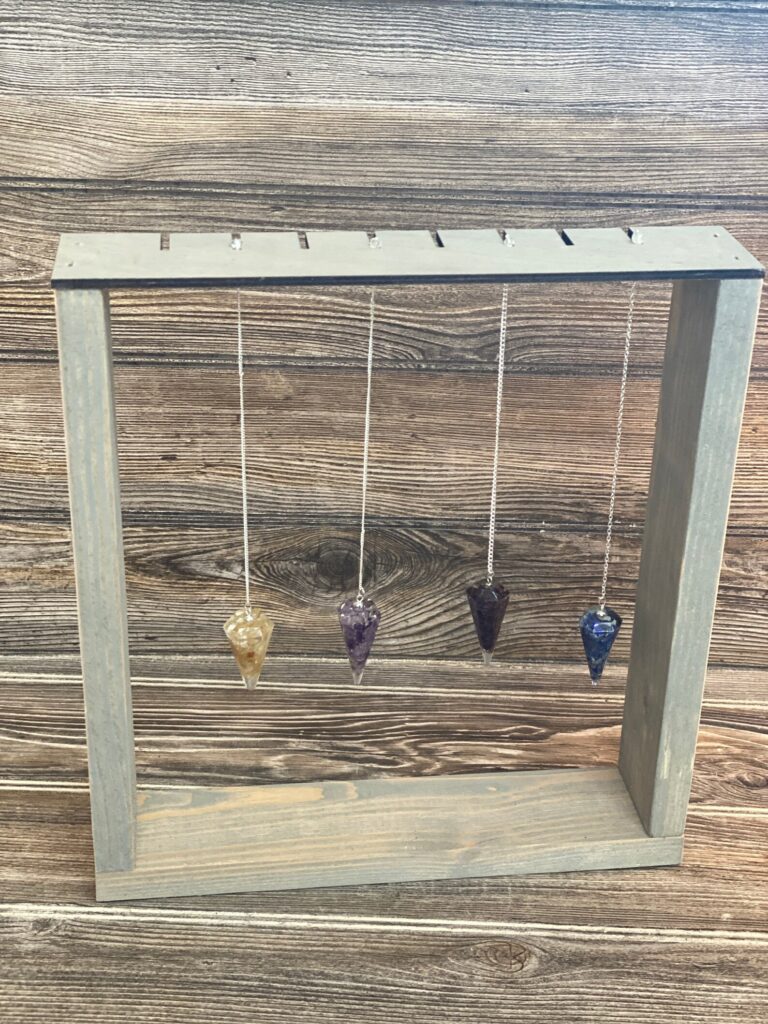
You’ll find pendulum stands in many forms, from basic wooden holders that cradle a single pendulum to elaborate displays that can showcase up to 16 pendulums at once. Some popular options include moon phase designs, crystal displays with built-in trays, and handcrafted wooden stands with multiple holding points.
You can even make your own pendulum stand using common household items. Creative DIY options range from repurposed containers to custom-built wooden displays. The key is ensuring your stand keeps the pendulum secure while allowing it to hang freely when in use.
Understanding Pendulum Stands
A pendulum stand provides stability and support for your pendulum, allowing it to swing freely while maintaining consistent motion and accurate measurements. These stands come in various designs to suit different needs and applications.
Historical Context
The use of pendulum stands gained popularity in the 17th century with the rise of pendulum clocks. Scientists like Galileo used simple wooden stands to study pendulum motion and make groundbreaking discoveries about physics.
Early stands were often handcrafted from wood and metal, with designs ranging from simple wall brackets to elaborate freestanding structures.
Many universities and research labs created custom stands for specific experiments, leading to innovations in stand design and measurement techniques.
Basic Components
Your typical pendulum stand has three main parts: a stable base, a vertical support rod, and an attachment point at the top.
The base needs to be heavy enough to prevent tipping and usually includes leveling feet for precise adjustments.
The support rod must be rigid and perfectly vertical to ensure accurate pendulum motion. Many stands use steel or aluminum rods for durability.
The attachment point often features a clamp or hook system that lets you easily change pendulums or adjust the length of the string.
Some modern stands include measurement markings and protractors to help track the pendulum’s swing angle and period.
Design and Functionality
A pendulum thrust stand measures forces with precision using gravity and carefully designed components. These specialized instruments help engineers test and evaluate propulsion systems through exact measurements.
Materials and Durability
Pendulum stands use high-quality flexures and bearings to ensure accurate measurements. These components come from specialized manufacturers like C-Flex Bearing Corporation.
The stands need strong, lightweight materials to handle testing loads up to 125 kg while maintaining sensitivity.
Key components include torsional flexures, pivot points, and support structures made from durable metals that resist wear and temperature changes.
Types of Pendulum Stands
Hanging Pendulum
- Simplest design
- Uses gravity for stability
- Great for basic measurements
Inverted Pendulum
- More complex setup
- Higher sensitivity
- Better for small force detection
Torsional Pendulum
- Specialized design
- Measures rotational forces
- Uses unique flexure system
Mechanism of Operation
Your pendulum stand works by converting thrust forces into measurable movement. The thruster mounts within the pendulum arms, creating a nested design for better sensitivity.
The stand uses position sensors to track tiny movements. These movements directly relate to the thrust being measured.
Most designs aim for a linear response to make measurements easier to interpret. Springs and dampers help control the pendulum’s motion and improve accuracy.
The measurement range typically spans from 100 micronewtons to 100 newtons, making these stands perfect for testing various propulsion systems.
Applications
A pendulum stand supports various tools used in research labs, schools, and homes, making it a versatile piece of equipment for multiple purposes.
Scientific Research
Pendulum stands play a key role in physics experiments and measurements. Your research setup can include precision pendulums for studying gravity, motion, and energy conservation.
These stands let you adjust the length and angle of pendulums with high accuracy. You can measure period, frequency, and amplitude while keeping other variables constant.
Seismologists use specialized pendulum stands to detect and record earth movements. The stands keep sensors stable and properly aligned for accurate readings.
Educational Purposes
Teachers use pendulum stands to demonstrate physics concepts to students. You can easily show how pendulum motion relates to gravity and energy.
The stands allow students to conduct hands-on experiments safely. You can adjust heights and weights to explore different variables.
Simple demonstrations help explain complex ideas like harmonic motion and conservation of energy. Students can see real-world physics in action.
Decorative Uses
Pendulum stands enhance the appearance of grandfather clocks and fancy timepieces. You might spot ornate brass or wooden stands holding clock pendulums.
Artists create kinetic sculptures using pendulum stands. The stands support moving parts that create patterns and visual effects.
Some people use decorative stands to display crystal or metal pendulums. These make eye-catching focal points in rooms or meditation spaces.