
Have you ever stumbled upon a shiny golden mineral while exploring outdoors? You might have discovered pyrite, also known as “fool’s gold.” This fascinating mineral has captured the imagination of rock enthusiasts and collectors for centuries with its metallic yellow shine and perfect cubic crystals.
If you want to learn more about pyrite uses and benefits, this guide explains the main ways it is valued.
Pyrite forms naturally in many places, from sedimentary rocks like limestone and shale to hydrothermal veins deep within the earth. You can find this common sulfide mineral in mines, rocky outcrops, and various geological formations across the world. The United States offers many great spots to search for pyrite, especially in mining districts and mountain ranges.
The beauty of pyrite lies in its perfect crystal shapes and brilliant metallic luster. When you spot these golden cubes gleaming in the sunlight, you’ll understand why early prospectors often mistook it for real gold. As the most abundant sulfide mineral on Earth, your chances of finding pyrite specimens during your rock hunting adventures are quite good.
The Basics of Pyrite
Pyrite’s distinctive golden color and metallic shine make it one of the most recognizable minerals you’ll find. Its nickname “Fool’s Gold” comes from its sparkly appearance that has tricked many hopeful prospectors.
Chemical Composition and Crystal Structure
Pyrite is made of iron sulfide (FeS2), with iron and sulfur atoms bonded together in a unique cubic arrangement. Each iron atom links to six sulfur atoms, creating a strong and stable structure.
The crystal structure gives pyrite its famous cube-shaped formations. You’ll often see perfect cubic crystals with smooth, shiny faces.
Some pyrite forms in twelve-sided shapes called pyritohedrons, which look like slightly modified cubes with extra angles.
Physical Properties: Color, Form, and Hardness
Pyrite has a bright, brassy-yellow color that looks very similar to gold. Its metallic luster makes it highly reflective and sparkly.
The mineral ranks 6-6.5 on the Mohs hardness scale, making it much harder than gold. You can test this by trying to scratch it with a steel nail.
Pyrite’s specific gravity is about 5, which means it’s five times heavier than water. When you pick up a piece, you’ll notice it feels quite heavy for its size.
Fresh pyrite surfaces have a bright, metallic shine. The mineral can tarnish over time, developing darker spots or a rainbow-colored coating.
Formation and Geology
Pyrite forms in many different environments, from deep underground in hot magma to shallow seas filled with ancient marine life. The mineral needs specific conditions to grow, including iron, sulfur, and low oxygen levels.
Pyrite in Sedimentary Environments
You’ll find pyrite in sedimentary rocks where organic matter decays without much oxygen. This creates perfect conditions for pyrite to grow.
Mud at the bottom of ancient oceans and lakes often trapped dead plants and animals. As this material broke down, bacteria produced sulfur that combined with iron to form pyrite crystals.
Coal deposits are great places to spot pyrite. The mineral appears as shiny golden specks or larger crystal clusters within the dark coal layers.
Crystals in Igneous and Metamorphic Rocks
Hot fluids flowing through cracks in rocks create beautiful pyrite crystals. These hydrothermal veins form when mineral-rich water heats up deep underground.
You can spot pyrite in granite and other igneous rocks that formed from cooling magma. The mineral grows into perfect cube shapes when it has space to form slowly.
In metamorphic rocks, heat and pressure can make pyrite crystals grow larger or change shape. Look for pyrite in marble and slate where the original sedimentary rocks transformed under intense conditions.
Pyrite Around the World
Pyrite forms in many places across Earth, creating stunning metallic crystals in mines and natural deposits. Each region produces unique varieties with different crystal shapes and qualities.
Notable Pyrite Mines
The Eagle Mine in Colorado stands out as one of your best chances to find high-quality pyrite specimens. You’ll discover beautiful cubic crystals embedded in white quartz matrices here.
Spain’s Rio Tinto mines have produced some of the world’s most sought-after pyrite specimens. The crystals from these historic mines often show perfect cubic formations.
The Black Pearl Mine in Arizona offers you a chance to find pyrite in limestone and shale deposits. The desert location creates unique formation conditions that result in exceptionally shiny specimens.
Global Pyrite Deposits
You can find major pyrite deposits across several continents. Italy’s Elba Island and Piedmont region are famous for producing large, well-formed crystals.
Kazakhstan holds significant deposits where you’ll find pyrite mixed with other minerals. The country’s varied geology creates perfect conditions for pyrite formation.
The Andes Mountains contain rich pyrite zones throughout their range. You might spot the mineral in both igneous and sedimentary rocks here.
Germany and France have productive areas where you can discover pyrite in metamorphic rocks. These European deposits often yield specimens with unique crystal patterns.
Identifying Pyrite
Pyrite has distinct features that make it stand out among other minerals. Looking at its unique crystal shapes and brass-yellow color will help you spot it in the field.
Distinguishing Features
Pyrite always shows a bright brass-yellow color with a metallic shine. You’ll notice it forms perfect cube-shaped crystals or 12-sided shapes called pyritohedrons.
When you scratch pyrite on a testing plate, it leaves a black streak with a slight green tint. This is very different from gold’s yellow streak.
You can test its hardness too – pyrite ranks at 6-6.5 on the Mohs scale. Try scratching it with a steel nail. The nail won’t leave a mark on real pyrite.
Look for striations (parallel lines) on the crystal faces. These natural etchings are a classic pyrite trademark.
Common Confusions with Other Minerals
Gold is the most common mix-up with pyrite. While both are yellow and shiny, gold forms rounded nuggets or flakes. Pyrite makes angular crystals.
Chalcopyrite can look similar but has a more golden-yellow color that often shows rainbow tarnish. It’s also softer than pyrite.
Marcasite shares pyrite’s chemical makeup but forms different crystal shapes. You’ll see spear-like crystals instead of cubes.
Watch out for fake pyrite in shops. Real pyrite has consistent color and naturally formed crystal faces. Fakes often show uneven coloring or artificial-looking surfaces.
Pyrite’s Many Faces
Pyrite shows up in several eye-catching crystal shapes that sparkle with a metallic gold shine. You can find these beautiful formations in mines, quarries, and rock outcrops worldwide.
Crystal Habits and Varieties
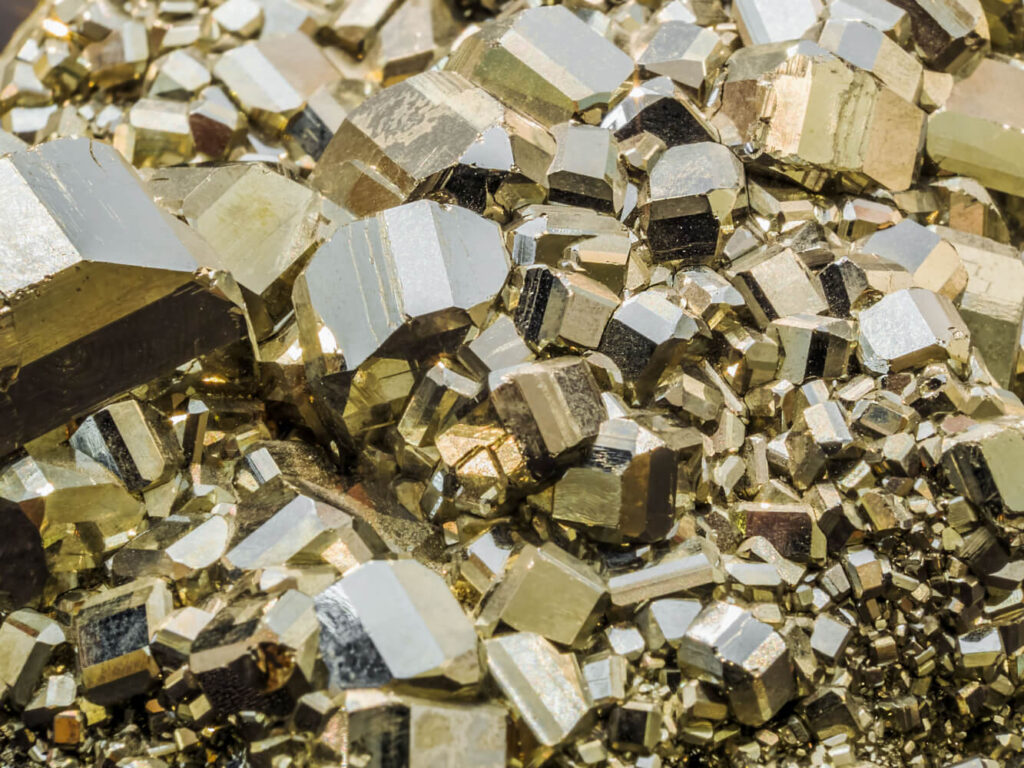
The most common pyrite crystal shape you’ll find is the perfect cube. These cubic crystals have six square faces that meet at right angles, creating stunning geometric specimens. You might spot tiny lines called striations on the crystal faces – these are a helpful clue for identifying pyrite.
Pyrite also forms as octahedrons, which look like eight-sided diamonds. Some pieces combine both cube and octahedron shapes into complex patterns.
The pyritohedron is another special form. It has 12 five-sided faces in a twisted cube-like shape that’s unique to pyrite.
Unique Crystal Forms
You can find pyrite in clusters of tiny spherical crystals called framboids. These raspberry-shaped groups often appear in sedimentary rocks like shale and limestone.
Some pyrite crystals grow into flat discs or thin plates. Others form branching tree-like patterns or masses of intergrown crystals.
The crystal faces often have a bright, mirror-like shine that makes pyrite stand out. Fresh pieces have a rich brass-yellow color that gave pyrite its nickname “fool’s gold.”
Many crystals show perfect right angles and sharp edges when they form without interference from other minerals.
Practical Uses of Pyrite
Pyrite has played an important role in many industries throughout history, from creating essential chemicals to modern technological applications.
Historical and Modern Industry
Your local hardware store probably stocks products made with sulfuric acid – and pyrite helped make that possible! Mining companies used to extract large amounts of pyrite to produce sulfur and sulfuric acid for industrial use.
Today, most sulfur comes from oil and gas processing instead. Some mining operations still extract pyrite as a byproduct when mining for gold.
Construction companies need to test for pyrite before building. When pyrite oxidizes, it can damage foundations, floors, and pavement.
Pyrite in Technology and Science
You might find pyrite in some modern electronic devices. Scientists use it as a natural semiconductor material in solar cells and other technologies.
Research teams study pyrite’s unique properties to develop better solar panels. Its ability to convert sunlight into electricity makes it valuable for renewable energy research.
Geologists use pyrite formations to understand ancient environments. The mineral’s presence can tell you about the conditions when rocks formed millions of years ago.
Be careful if you collect pyrite samples – when exposed to air and water, it can form iron sulfate and contribute to acid drainage in the environment.
Environmental Impact
Pyrite can cause serious problems when it mixes with water and air. The good news is that modern mining practices can help protect the environment.
Oxidation and Acid Drainage
When pyrite comes into contact with water and oxygen, it starts to break down through a process called oxidation. This creates sulfuric acid and iron hydroxide, which can be very harmful to the environment.
The acid formed from pyrite can seep into nearby streams and groundwater. This is called acid mine drainage, and it makes the water too acidic for fish and plants to survive.
You’ll often find this problem in old mining sites where pyrite-rich rocks were left exposed. The acid can also dissolve other harmful metals from surrounding rocks, making the water even more toxic.
Responsible Mining Practices
You can help protect the environment by supporting mines that use proper waste management techniques. Modern mines now store pyrite-containing materials underwater or in sealed containers to prevent oxidation.
Mining companies use special liners and drainage systems to catch any acid that might form. They also test the surrounding water regularly to make sure it stays clean.
Some mines add limestone to neutralize acidic water before it reaches the environment. This helps keep nearby streams and groundwater safe for plants and animals.
Beyond the Ore: Pyrite in Culture
Pyrite holds deep cultural meaning across many societies, connecting people to themes of abundance and spiritual protection through the ages.
Pyrite in Folklore and Mythology
Ancient cultures valued pyrite for its sun-like golden shine. Native American tribes used it in healing ceremonies and believed it could ward off negative energy.
In Peru, the Inca saw pyrite as a magical stone that bridged the physical and spiritual worlds. They placed it in temples and royal buildings to attract divine blessings.
Spanish miners named it “petra del fuego” (fire stone) because it creates sparks when struck against metal. This sparked stories of pyrite having fire-protection powers.
The Stone of Prosperity
In Feng Shui practice, you can place pyrite in the wealth corner of your home or office to attract abundance. Many practitioners recommend putting it on your desk or near the front door.
The stone’s reflective surface is said to multiply positive energy in your space. Its golden color connects to themes of success and personal power.
Placement tips for prosperity:
- Keep a piece by your computer while working
- Place three pieces in a triangle shape for balance
- Display it in the southeast area of your space
- Combine with green plants to boost growth energy
The Collector’s Corner
Building a pyrite collection lets you enjoy these shimmering specimens up close. Many collectors seek out unique crystal formations and special pieces to display.
Collectible Pyrite Specimens
The best pyrite specimens show off clear crystal faces and bright metallic shine. Look for cubes, octahedrons, and pyritohedrons when picking pieces for your collection.
Some of the most prized specimens come from Spain’s Navajún region, known for perfect cubic crystals.
Key features to check when selecting specimens:
- Sharp, well-formed crystal faces
- Bright, metallic luster
- Clean surfaces without rust spots
- Stable matrix (surrounding rock)
Iridescent pyrite, showing rainbow colors on its surface, makes an eye-catching addition to any collection.
Display and Care for Your Pyrite Collection
Keep your pyrite specimens in display cases or on shelves away from high humidity. Moisture can cause pyrite to break down over time.
Use soft brushes to clean dust from your specimens. Never use water or cleaning products, as these can damage the crystals.
Display tips:
- Place specimens on acrylic stands to show off crystal faces
- Add LED lighting to highlight metallic surfaces
- Use clear cases to protect from dust
- Label each piece with its location and date found
Store your collection at room temperature in a dry space. Check pieces regularly for signs of deterioration.
Interactions with Organic Material
Pyrite forms strong connections with organic materials in nature, creating fascinating patterns and structures. These interactions play a key role in preserving ancient life forms and creating mineral deposits.
Pyrite and Fossils
When organisms die and get buried in sediments, pyrite often replaces their soft tissues. This process creates detailed fossil preservations that let you see incredible features from ancient life forms.
Pyrite forms special raspberry-shaped clusters called framboids around organic matter. You can find these tiny spherical formations in coal deposits and other places rich in ancient plant and animal remains.
The mineral helps preserve delicate structures like shells, bones, and plant materials. When you look at pyrite fossils, you’re seeing an exact mineral copy of creatures that lived millions of years ago.
The Role of Bacteria in Pyrite Formation
Certain bacteria love to eat sulfur compounds and create conditions perfect for pyrite growth. These tiny organisms release sulfide that combines with iron to form pyrite crystals.
In oxygen-poor environments like deep sea mud, bacteria thrive and help create pyrite deposits. You’ll often find pyrite forming around bacterial colonies in these settings.
The bacteria create small spaces where pyrite can grow more easily. This process happens in modern environments and played a big part in forming ancient pyrite deposits that you might find today.