
Have you ever wondered how those beautiful crystals in your local rock shop came to be? The process is more simple than you might think – it all starts with tiny particles coming together.
When atoms or molecules join up in an organized pattern, they form a crystal structure that grows larger over time through a process called crystallization. You can see this happen when you make rock candy at home or watch salt crystals form as water evaporates.
Nature creates crystals in many ways, from cooling magma deep underground to mineral-rich water seeping through rock cavities. Some crystals take just days to form while others need millions of years. Whether they grow in geometric cubes like salt or hexagonal points like ice, each crystal type follows its own unique pattern as it builds up one particle at a time.
Understanding Crystal Basics
Crystals are ordered arrangements of atoms that follow specific patterns and rules. These fascinating structures appear in nature and can be made in labs.
If you’re wondering about the difference between a crystal and a rock, this guide explains it clearly.
Defining Crystals and Crystallography
A crystal is a solid material where atoms line up in regular, repeating patterns. Think of it like building blocks stacked in perfect rows.
Crystallography is the science that studies how these atoms arrange themselves. You can spot crystals by their flat faces and sharp edges.
When atoms join together, they form what scientists call a crystalline solid. These solids have special properties that make them useful in jewelry, electronics, and medicine.
Crystal Systems and Symmetry
Crystals form in six main systems based on their atomic arrangements:
- Cubic: Like a dice shape
- Tetragonal: Like a stretched cube
- Hexagonal: Six-sided shapes
- Orthorhombic: Three different lengths
- Monoclinic: Tilted shapes
- Triclinic: Most irregular form
Each crystal system shows different types of symmetry. You can rotate or flip these shapes in certain ways, and they’ll look the same.
The way atoms pack together determines if you’ll get gems like diamonds (cubic) or quartz (hexagonal). These patterns affect the crystal’s strength, color, and other properties.
The Science of Crystal Structure
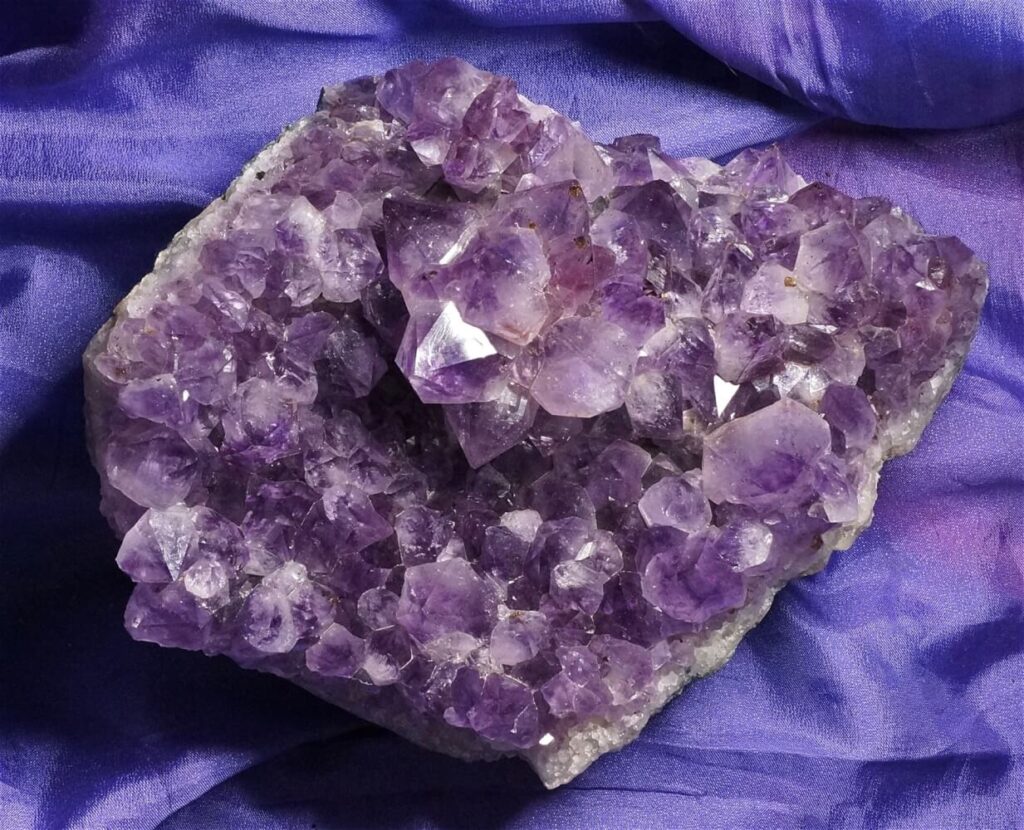
Crystal structures follow precise patterns that repeat throughout the entire crystal. These patterns create beautiful shapes and give crystals their unique properties.
Unit Cells and Crystal Lattice
A crystal lattice is like a 3D grid made up of tiny building blocks called unit cells. Think of unit cells as the smallest piece of the crystal that shows its complete pattern.
When you look at a crystal, you’re seeing millions of these unit cells stacked together. Each unit cell contains atoms arranged in specific ways.
Some crystals form cube-shaped unit cells, while others might form hexagonal or pyramid shapes. These patterns determine what the final crystal will look like.
Cell Parameters and Axes
Your crystal’s unit cell has three main measurements called axes. Scientists label these as a, b, and c-axes to track the cell’s dimensions.
The a-axis typically runs from left to right, while the c-axis points up and down. These axes help you understand how the crystal grows.
The angles between these axes matter too. They can be 90 degrees like in a cube, or different angles that create unique crystal shapes.
Scientists use these measurements to group crystals into families based on their structure. You might find some crystals that share the same basic pattern but look different because of their chemical makeup.
From Structure to Shape
The arrangement of atoms inside a crystal determines its outward shape, creating distinct patterns and forms we can see with our eyes.
Crystal Formation Processes
When crystals grow, they stack atoms in a regular, repeating pattern. Think of it like building with tiny blocks – each new atom connects to others in specific ways.
Your crystal’s final shape depends on the conditions during its growth. Temperature, pressure, and available space all play a role in how the crystal develops.
Some crystals grow quickly in one direction and slowly in others. This creates long, needle-like shapes. Others grow evenly in all directions to form cubes or other regular shapes.
Geometric Forms of Crystals
You can spot different crystal forms in nature. Some common shapes include cubes, pyramids, and prisms.
Basic Crystal Forms:
- Cubic (like salt crystals)
- Hexagonal (like quartz points)
- Pyramidal (like some gemstones)
- Prismatic (like tourmaline)
Each crystal type has its own preferred shape, based on its internal structure. These shapes help you identify what kind of crystal you’re looking at.
Crystal forms can combine in interesting ways. A single crystal might show faces from two or more different geometric shapes at once.
Natural crystals don’t always form perfect shapes. Growth conditions can cause them to develop irregular or rounded faces while still following their basic structural patterns.
Diversity of Shapes and Textures
Crystals display amazing variety in their shapes and structures. Each type forms unique patterns based on its chemical makeup and the conditions where it grows.
Common Crystal Habits
Crystal habits are the typical shapes that minerals form as they grow. You’ll notice some crystals grow as cubes, like salt or pyrite, while others form long columns or needles.
Some crystals appear as flat plates stacked together, creating beautiful layered patterns. Others grow in clusters that look like pyramids pointing outward from a central point.
The environment plays a big role in how crystals develop their shapes. Temperature, pressure, and available space all affect the final form you’ll see.
Unique Features: Faces and Edges
Crystal faces are the flat, smooth surfaces that make up the outside of the crystal. You can spot these shiny surfaces catching light at different angles.
Each face connects to others along straight lines called edges. These edges meet at points, creating the crystal’s distinctive geometric shape.
Some crystals have just a few large faces, while others display many smaller ones. The number and arrangement of faces help you identify different mineral types.
Crystal faces often show special patterns like striations (tiny parallel lines) or growth marks that tell the story of how the crystal formed.
Crystal Growth and Formation
Crystals start as tiny clusters of atoms that grow into beautiful geometric shapes through slow, precise organization. The way they form depends on both basic growth rules and their surroundings.
Principles of Crystal Growth
When you look at a growing crystal, you’re watching atoms line up in an organized pattern. These atoms stick together like building blocks in very specific ways.
Your crystal needs a starting point called a “seed” to begin growing. Think of it like a tiny template that other atoms copy.
The speed of growth matters a lot. Slow growth usually creates the most perfect crystals, while fast growth can lead to defects or irregular shapes.
Environmental Factors Impacting Growth
Temperature plays a big role in how your crystals form. Warmer conditions often speed up growth, while cooler temperatures slow it down.
The solution or environment where crystals grow needs to be supersaturated – meaning it contains more dissolved material than it can normally hold.
Key growth factors include:
- Amount of space to grow
- Presence of other minerals
- Water or solution purity
- Pressure conditions
Tiny bits of dirt or other minerals can change how your crystal looks. These impurities might create unique colors or affect the crystal’s shape.
Catalogue of Crystal Varieties
Crystals come in many shapes, sizes, and chemical compositions. The natural world produces an amazing range of crystal types, each with unique properties and formation patterns.
Describing Mineral Examples
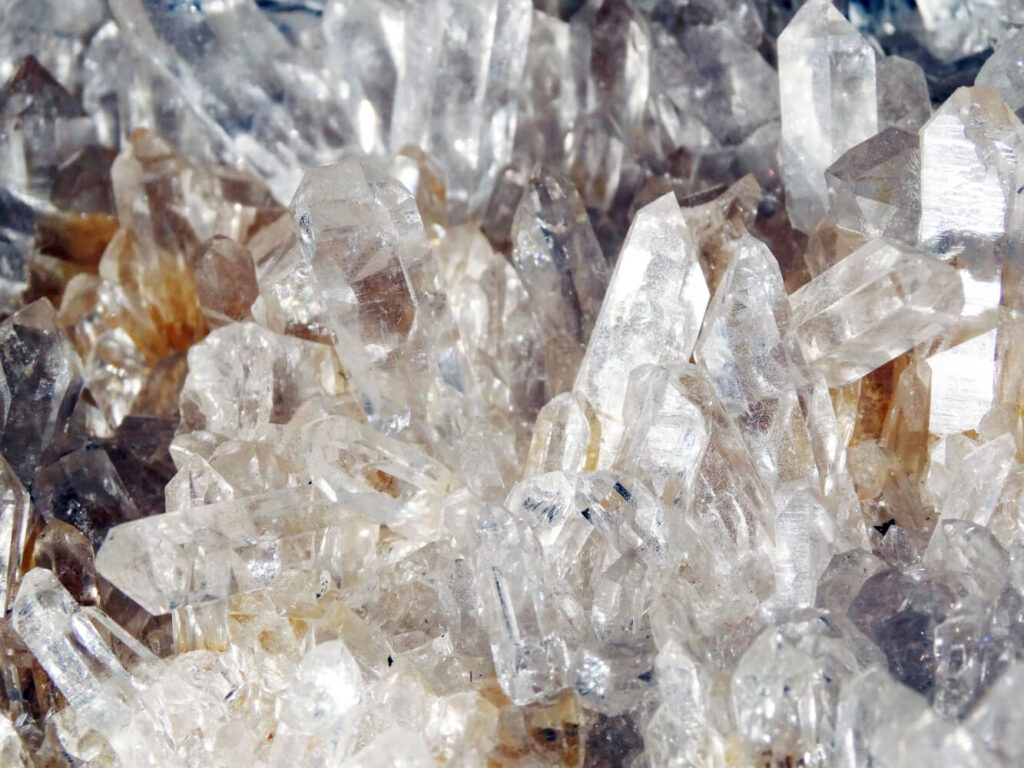
Quartz stands as one of the most common crystals you’ll find in nature. It forms clear, six-sided prisms that can grow quite large.
Beryl creates beautiful crystals in several colors. You might know its green form as emerald or its blue variety as aquamarine.
Fluorite grows in perfect cubic shapes and comes in purple, green, and blue colors. Its crystals often form in layers with different shades.
Malachite creates bright green bands and swirls. You can spot it by its distinctive pattern and rich color.
Crystal Classes and Their Properties
Cubic System:
- Fluorite
- Copper
- Pyrite
Hexagonal System:
- Quartz
- Beryl
- Tourmaline
Crystal shapes help you identify different minerals. The way atoms line up inside creates specific patterns and angles.
Some crystals form hollow shapes called “hoppers.” These have well-formed edges but empty centers, like step-like patterns going inward.
Temperature affects how crystals grow. Hot conditions often create larger crystals, while cool temperatures can lead to smaller formations.
Advanced Concepts in Crystallography
Crystal structures follow specific mathematical rules and patterns that help scientists predict their behavior and properties. These patterns create unique shapes and directions that make each crystal special.
Miller Index and Crystalline Directions
The Miller Index helps you locate specific planes within a crystal using three simple numbers (h,k,l). Think of it like a 3D map that points to exact spots in the crystal structure.
When you look at a crystal, you’ll notice flat surfaces called faces. The Miller Index tells you which way these faces point. For example, (100) means the face is parallel to the y and z axes.
Here are common Miller Index notations:
- (hkl) = A single plane
- {hkl} = A set of similar planes
- [uvw] = A direction in the crystal
= A set of similar directions
Symmetry Operations and Crystal Systems
Symmetry shows you how a crystal looks the same when you move it in certain ways. A cube, for instance, looks identical after rotating it 90 degrees.
The main symmetry operations you’ll see in crystals are:
- Reflection: Like looking in a mirror
- Rotation: Spinning around a fixed point
- Inversion: Flipping through the center
- Rotoinversion: A mix of rotation and inversion
These operations create seven basic crystal systems:
- Cubic
- Tetragonal
- Hexagonal
- Trigonal
- Orthorhombic
- Monoclinic
- Triclinic
Each system has its own special symmetry rules that make crystals form their unique shapes.
Physical Properties of Crystals
Crystals have unique traits based on how their atoms line up in specific patterns. These patterns create special qualities that make each crystal type different from others.
Mechanical Characteristics
The way atoms bond in crystals gives them their strength and durability. Some crystals can be quite hard, while others might be softer and more fragile.
Crystal hardness follows the Mohs scale, ranging from 1 (very soft) to 10 (super hard). Diamond ranks at 10, making it one of the hardest natural materials you’ll find.
You can scratch softer crystals with harder ones. For example, a quartz crystal (hardness 7) will easily scratch calcite (hardness 3).
Some crystals can split along flat surfaces called cleavage planes. This happens because of weak bonds between certain layers of atoms.
Electrical and Thermal Conductivity
Different crystals carry heat and electricity in unique ways. Some conduct really well, while others block these forces.
Metal crystals like copper are great conductors because their electrons move freely through the crystal structure. You’ll find these crystals in many electronic devices.
Some crystals create electricity when squeezed or heated. Quartz watches use this property to keep accurate time.
Heat moves through crystals differently depending on their atomic structure. Diamond conducts heat better than most materials, which is why it feels cold to touch.
Applications of Crystals in Everyday Life
Crystals play a vital part in modern life, from powering your electronic devices to adding beauty to your home.
Crystals in Technology and Industry
Your smartphone screen relies on liquid crystals to display images and text. Quartz crystals in watches help keep precise time by vibrating at exact frequencies. These same crystals work in computer processors and memory chips.
Electronic sensors use crystals to convert physical movements into electrical signals. This makes them essential in microphones, speakers, and medical ultrasound machines.
Salt production uses crystallization to create the table salt in your kitchen. Many medications also form through crystal growth during manufacturing.
Decorative and Collectible Crystals
You can display geodes as natural artwork in your home. These hollow rocks lined with sparkling crystals create eye-catching focal points.
Banded crystals like agate show beautiful stripes of color. Their patterns form naturally as minerals build up in layers over time.
Crystal clusters work well as bookends or desk decorations. Their geometric shapes and natural sparkle add interest to any room.
Jewelry makers set crystals into rings, necklaces, and bracelets. The crystals’ natural facets catch light and create brilliant sparkles.
Visualizing Crystals
Modern tools let you see the amazing internal patterns of crystals at different scales and angles.
Crystals Under the Microscope
When you look at crystals through a microscope, you can spot their clean edges and smooth faces. These shapes give clues about how atoms line up inside.
X-ray imaging reveals even more detail by showing the precise arrangement of atoms. You can see how salt forms perfect cubes, while snowflakes create six-sided patterns.
Some crystals look different when viewed from various angles. Moving the crystal under the microscope helps you spot these changes in shape and pattern.
The Role of Technology in Studying Crystals
Computer programs create 3D models that show you exactly how crystals are built. You can rotate these models, zoom in on specific parts, and even peek inside the crystal structure.
Special animation software lets you watch how crystals grow step by step. You’ll see atoms lock into place as the crystal takes shape.
Modern tools can slice through virtual crystals to examine their internal planes. This helps you understand how different crystal shapes form.
You can use these programs to compare various crystal types side by side and spot their unique features.