
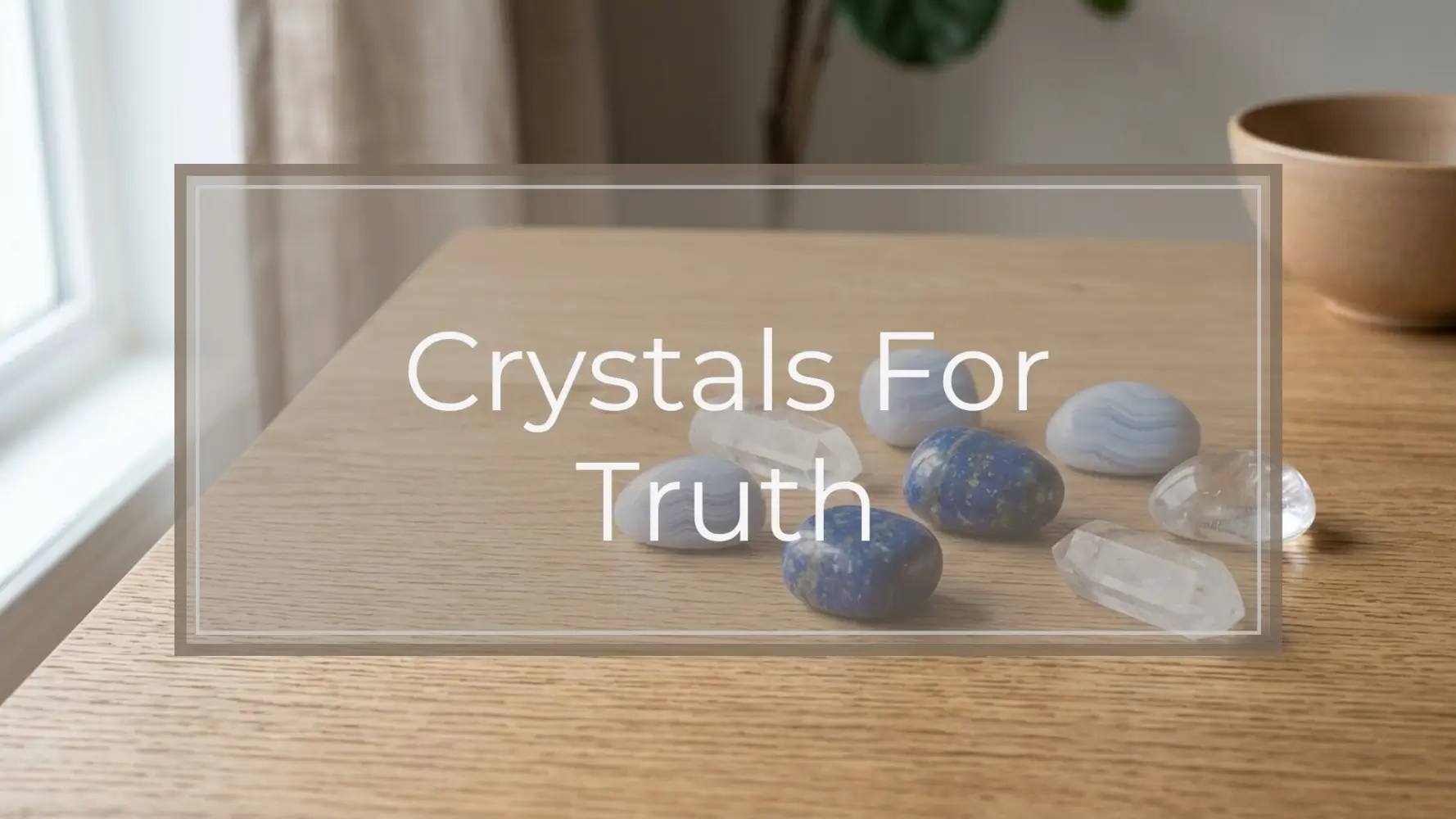
Crystals for truth are commonly chosen as mindful reminders for honest communication, clearer thinking, self-reflection, and the courage to say what needs to be said. The best options depend on what kind of truth you are working with: speaking honestly, understanding your own feelings, sorting facts from assumptions, or facing something you have been avoiding.
Quick verdict: The best crystals for truth are lapis lazuli for honest communication, sodalite for clear thinking, blue lace agate for calm truth-telling, amazonite for speaking from the heart, clear quartz for clarity, obsidian for self-honesty, and amethyst for intuition. Use them as mindful reminders during journaling, conversations, meditation, or personal reflection rather than as guaranteed solutions.
No crystal can force someone to tell the truth, reveal secrets, or guarantee the outcome of a difficult conversation. But a carefully chosen stone can become a useful focus point: a symbol of the kind of honesty you want to practice and the way you want to show up.
The Best Crystals for Truth at a Glance
Crystals for truth are usually selected for one of four reasons: they are associated with the throat chakra and communication, they support clarity and reflection, they encourage courage and self-honesty, or they help soften the emotional charge around difficult conversations.
Here is a quick comparison before we look at each stone in more detail.
| Crystal | Best For | How to Use | Tradeoff or Note |
|---|---|---|---|
| Lapis Lazuli | Honest expression, integrity, wisdom | Wear near the throat, hold while journaling, keep on a desk | Can feel intense if you want a softer stone |
| Sodalite | Clear thinking and sorting facts from assumptions | Use during planning, research, or reflective writing | More mental than emotional |
| Blue Lace Agate | Calm, gentle truth-telling | Carry before hard talks or hold while practicing words | Subtle; less suited for deep shadow work |
| Amazonite | Speaking from the heart | Use before boundaries, emotional conversations, or journaling | Better for authenticity than “investigating” truth |
| Clear Quartz | Amplifying a truth-focused intention | Pair with another stone or use in a simple ritual | Very broad; needs a clear intention |
| Amethyst | Intuitive truth and spiritual reflection | Meditate with it or keep near a journal | More inward and intuitive than verbal |
| Fluorite | Organizing thoughts and seeing patterns | Use while studying, planning, or reviewing mixed information | Analytical rather than heart-centered |
| Obsidian | Self-honesty and shadow work | Use during deep journaling or personal reflection | Can feel emotionally intense |
| Smoky Quartz | Grounding uncomfortable realizations | Hold during reflection or after difficult talks | Less communication-focused |
| Tiger’s Eye | Courage to act on the truth | Carry when taking a practical next step | Action-oriented; pair with calming stones if needed |
The best crystal for you depends on your truth-related goal. If you want to speak more clearly, start with lapis lazuli or blue lace agate. If you need to understand what is actually true, try sodalite or fluorite. If the truth is emotional, amazonite may feel more supportive. If you are facing personal patterns or avoidance, obsidian and smoky quartz are stronger choices.
1. Lapis Lazuli — Best Overall Crystal for Truth and Honest Expression
Best for: honest conversations, personal integrity, thoughtful self-expression.
Lapis lazuli is one of the most widely recommended crystals for truth because of its long-standing associations with wisdom, integrity, insight, and communication. Its deep blue color also connects it symbolically with the throat chakra, which is often linked to speaking honestly and expressing yourself clearly.
If you want one all-purpose crystal for truth, lapis lazuli is the strongest place to start. It works well when your goal is not just to “say something,” but to speak with both honesty and responsibility. It is especially useful for moments when you need to communicate clearly without becoming reactive, vague, or overly guarded.
Practical ways to use lapis lazuli include:
- Wearing it as a pendant near the throat before an important conversation
- Holding it while journaling about what you truly think or feel
- Placing it on your desk before writing an email, letter, speech, or message
- Keeping it nearby during a personal integrity check: “Am I saying what I really mean?”
A simple intention for lapis lazuli is:
“I choose words that are honest, clear, and kind.”
The tradeoff is that lapis lazuli can feel symbolically intense. If you are nervous about confrontation or tend to be hard on yourself, you may prefer to pair it with a softer stone such as blue lace agate or amazonite. Lapis lazuli is excellent for truth, but it works best when truth is balanced with timing, compassion, and self-awareness.
2. Sodalite — Best for Mental Clarity and Sorting Out the Facts

Best for: separating facts from assumptions, reducing mental clutter, thoughtful decision-making.
Sodalite is a practical crystal for truth when you need clear thinking before you speak, decide, or act. It is often associated with logic, objectivity, and mental organization, making it a helpful choice when emotions, assumptions, or other people’s opinions are making a situation feel confusing.
This is the stone to reach for when you are asking questions like:
- “What do I actually know?”
- “What am I assuming?”
- “What evidence do I have?”
- “What is my emotional reaction, and what are the facts?”
Sodalite can be useful during research, planning, journaling, or preparation for a hard conversation. Keep it beside your notebook when you are trying to untangle a situation. You might write two columns: “facts” and “stories I am telling myself.” This simple practice can help you slow down and respond with more clarity.
Because sodalite is more mind-centered than heart-centered, it may not feel emotionally warm or comforting. If your truth work involves grief, vulnerability, or sensitive relationship conversations, consider pairing sodalite with amazonite or rose quartz. Sodalite can help you think clearly, but it should not be used as a way to detach from the human side of a situation.
Use it as a reminder to pause, question, and sort through information carefully. It is not about becoming cold or overly analytical; it is about making room for truth beneath mental noise.
3. Blue Lace Agate — Best for Calm, Gentle Truth-Telling
Best for: difficult talks, apologies, boundaries, and saying what needs to be said without escalating tension.
Blue lace agate is a softer communication stone often chosen for calm, gentle truth-telling. If lapis lazuli feels bold and direct, blue lace agate feels more soothing and patient. It is a good option for people who struggle to speak up because they fear conflict, overexplain when nervous, or worry their words will come out too sharply.
This crystal is especially helpful for practicing truth with compassion. That does not mean people-pleasing, hiding your needs, or avoiding necessary honesty. Instead, it supports the intention to speak in a way that is clear without being cruel.
Try using blue lace agate before:
- Apologizing sincerely
- Setting a boundary
- Asking for clarification
- Sharing a difficult feeling
- Practicing what you want to say out loud
You can carry it in your pocket before a conversation or hold it while rehearsing a few honest sentences. For example: “I care about this relationship, and I need to be honest about what is not working for me.”
The main tradeoff is that blue lace agate may feel too subtle for readers who want courage, intensity, or deep self-honesty. It is not the strongest choice for shadow work or confronting long-ignored patterns. But for everyday communication, emotional steadiness, and gentle honesty, it is one of the best crystals for speaking truth calmly.
4. Amazonite — Best for Speaking Your Truth from the Heart
Best for: emotional honesty, boundaries, authenticity, and values-based communication.
Amazonite is commonly associated with harmony between what you feel and what you say. It is often used as a heart-and-throat stone, making it a strong choice when truth is not only about facts, but also about emotional honesty and authenticity.
This crystal is useful when you know what is technically true, but you are still struggling to express what matters to you. Maybe you need to name a boundary, admit a desire, clarify your values, or stop agreeing to things that are not aligned with your needs.
Good moments to use amazonite include:
- Before setting a boundary
- While journaling about your needs
- During emotionally charged discussions
- When deciding whether your words match your values
- When you want to be honest without becoming defensive
A simple journaling prompt with amazonite is: “What do I keep minimizing that actually matters to me?”
The tradeoff is that amazonite is better for personal authenticity than investigative truth. It is not the stone you would choose for sorting complex information or uncovering hidden motives. It is more about your own inner alignment: what you feel, what you value, and what you are ready to express.
Amazonite also carries an important reminder: speaking your truth should still be respectful, safe, and appropriately timed. Honesty does not require impulsiveness. Sometimes the most truthful action is to pause, choose the right setting, and speak when you can do so clearly.
5. Clear Quartz, Amethyst, and Fluorite — Best Crystals for Clarity and Intuitive Truth
Not all crystals for truth are about speaking out loud. Some are better for recognizing what feels clear, aligned, or worth questioning. Clear quartz, amethyst, and fluorite are useful support stones when you are seeking clarity before communication.
Clear Quartz
Best for: amplifying a truth-focused intention and bringing simplicity to a ritual.
Clear quartz is one of the most versatile crystals. For truth work, its strength is focus. It can be used to amplify a specific intention, especially when paired with a more targeted stone such as lapis lazuli, sodalite, or obsidian.
Because clear quartz is broad, it works best when you give it a clear purpose. Instead of simply holding it and hoping for clarity, choose a direct intention such as: “I am willing to see this situation honestly.”
Amethyst
Best for: intuitive reflection, spiritual honesty, and quiet meditation.
Amethyst is often chosen for meditation, inner wisdom, and spiritual reflection. It is useful when truth feels quiet rather than obvious. This might be the kind of truth you sense in your body, dreams, repeated patterns, or moments of stillness.
Amethyst is not primarily a communication crystal. It is more inward and intuitive. Pair it with obsidian if you are doing deeper self-reflection, or with lapis lazuli if you want to turn inner insight into honest words.
Fluorite
Best for: organizing thoughts, noticing patterns, and making sense of mixed information.
Fluorite is helpful when the truth is buried under scattered details. It is often associated with mental order, pattern recognition, and focus. Use it when reviewing notes, making a decision, studying a situation, or trying to understand why something keeps repeating.
Fluorite pairs well with sodalite for logic and analysis. Together, they are a strong combination for truth and clarity when you need to think before you speak.
The tradeoffs are simple: clear quartz needs a specific intention, amethyst is more intuitive than verbal, and fluorite is more analytical than emotional. Use these stones when you need to understand the truth before expressing it.
6. Obsidian, Smoky Quartz, and Tiger’s Eye — Best for Self-Honesty and Courage
Some truth work is not about what other people say. It is about what you are ready to admit to yourself. Obsidian, smoky quartz, and tiger’s eye are often chosen for personal truth, shadow work, grounding, and courage.
These stones should not be used with the goal of making someone else tell the truth. Their better use is inward: noticing your own patterns, facing avoidance, and taking responsible action.
Obsidian
Best for: self-honesty, seeing patterns, and confronting what has been avoided.
Obsidian is one of the strongest stones for self-honesty. It is often associated with shadow work, reflection, and seeing what lies beneath the surface. Use it when you are ready to ask direct questions such as:
- “What am I avoiding?”
- “Where am I not being honest with myself?”
- “What pattern keeps repeating?”
- “What do I already know but do not want to admit?”
The tradeoff is intensity. Obsidian can feel heavy for some people, especially during emotionally charged reflection. Use it gently and take breaks.
Smoky Quartz
Best for: staying grounded while processing uncomfortable realizations.
Smoky quartz is a grounding crystal. It is not as communication-focused as lapis lazuli or blue lace agate, but it is useful when truth brings up discomfort, fear, or uncertainty. Keep it nearby after journaling, during quiet reflection, or following a difficult conversation.
Its tradeoff is that it supports grounding more than expression. Pair it with lapis lazuli if you need to speak after processing.
Tiger’s Eye
Best for: courage, confidence, and acting on what you know to be true.
Tiger’s eye is action-oriented. It is useful when you already know the truth, but you need confidence to make the next move. That might mean having a conversation, making a decision, changing a habit, or standing by a boundary.
Because tiger’s eye has a bold energy symbolically, it can be paired with blue lace agate if you want courage without harshness.
If self-reflection brings up distress, trauma, or overwhelming emotions, crystals are not a substitute for professional support. Use them as gentle tools alongside appropriate care, trusted community, and grounded decision-making.
How to Choose, Cleanse, and Use Crystals for Truth
The easiest way to choose crystals for truth is to identify your goal first. “Truth” can mean many things, and the right stone depends on the situation.
Use this simple guide:
- Speaking truth: lapis lazuli or blue lace agate
- Self-honesty: obsidian or smoky quartz
- Mental clarity: sodalite or fluorite
- Heartfelt honesty: amazonite
- Intuitive truth: amethyst
- Focused intention: clear quartz
- Courage to act: tiger’s eye
Once you choose a stone, keep the practice simple. You do not need a complicated ritual for it to be meaningful. The crystal works best as a physical reminder of your intention and the kind of honesty you want to practice.
Practical ways to use crystals for truth include:
- Holding one while journaling
- Carrying one in a pocket before a conversation
- Wearing one as jewelry, especially near the throat
- Placing one on your desk while writing or planning
- Meditating with one before making a decision
- Creating a small “truth altar” with a candle, notebook, and chosen stone
A short truth ritual can look like this:
- Cleanse the crystal if desired.
- Hold it in your hand and take a few slow breaths.
- Name the truth you are ready to face or express.
- Write one honest sentence in your journal.
- Choose one grounded next step.
For cleansing, use the method that fits your practice: smoke, sound, moonlight, selenite, or simple intention. If you prefer rinsing crystals, check water safety first. Some stones can be damaged by water, salt, or prolonged moisture.
Most importantly, do not use crystals as a test for whether someone else is lying. They are better used for discernment, communication, and personal responsibility. If you are unsure about a situation, combine intuition with observation, honest conversation, boundaries, and practical evidence.
FAQ
What crystal is best for telling the truth?
Lapis lazuli is the best overall crystal for telling the truth because it is strongly associated with wisdom, integrity, and honest communication. Blue lace agate is a softer choice if you want to speak calmly and gently.
What crystal helps you speak your truth?
Amazonite is often chosen for speaking your truth from the heart, especially around boundaries, needs, and authenticity. Lapis lazuli is better for clear expression, while blue lace agate supports calm and compassionate communication.
Can crystals reveal if someone is lying?
No. Crystals cannot reliably reveal lies, force honesty, or prove someone’s intentions. Use them as mindfulness tools for your own clarity, discernment, and communication rather than as a way to test or control another person.
Which chakra is connected to truth?
The throat chakra is most commonly connected to truth, communication, and self-expression. Blue stones such as lapis lazuli, blue lace agate, sodalite, and amazonite are often associated with this energy center.
How should I use crystals for honesty in a difficult conversation?
Choose lapis lazuli for clear truth, blue lace agate for calm delivery, or amazonite for heartfelt honesty. Hold the stone beforehand, write your main point in one sentence, and focus on being honest, respectful, and appropriately timed.
What is the best crystal combination for truth and clarity?
A strong combination is lapis lazuli with sodalite: lapis lazuli supports honest expression, while sodalite supports clear thinking. For deeper self-honesty, try obsidian with amethyst. For gentle communication, pair blue lace agate with amazonite.