
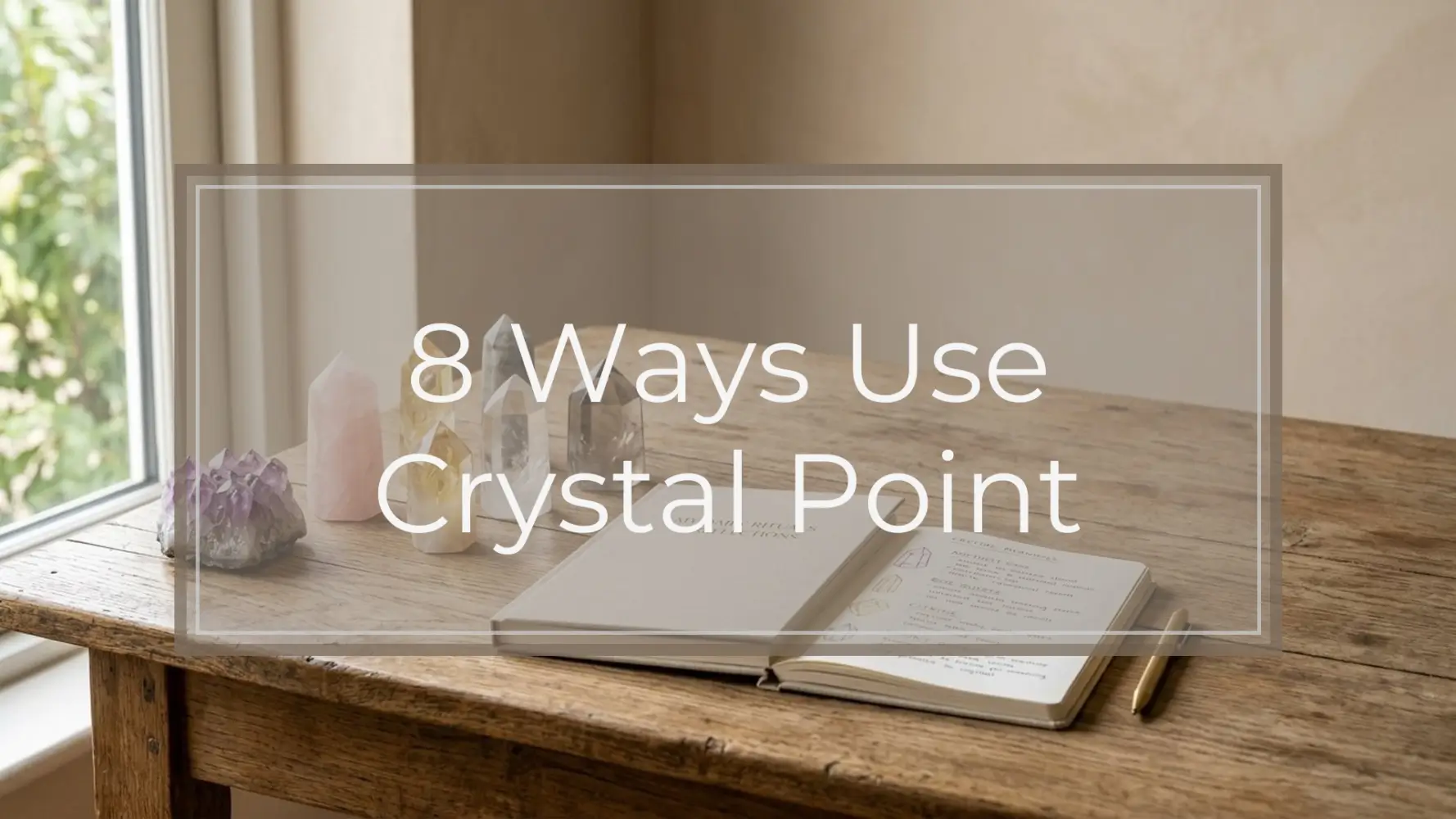
Crystal points are popular because their shape makes them easy to use with intention. A crystal point is a crystal with one or more pointed terminations, often used symbolically to focus, aim, or direct your attention during a spiritual practice.
Quick answer: The 8 ways use crystal point are to direct energy in meditation, set intentions, place it on an altar, use it in crystal grids, point it toward or away from the body, keep it on a desk or bedside table, cleanse or charge other crystals, and carry it as a mindful reminder. Always use crystal points as spiritual tools for focus and reflection, not as substitutes for medical, financial, or professional advice.
The point direction is usually symbolic: point outward to send, release, or extend an intention; point inward to invite, receive, or focus. Below is a beginner-friendly guide to using a crystal point in simple, grounded ways.
Quick Guide: 8 Ways to Use a Crystal Point
A crystal point can be natural or polished, large or small, single-terminated or double-terminated. What matters most is that the shape gives you a clear “direction” to work with. This makes it useful for meditation, intention setting, altar placement, crystal grids, room placement, and daily mindfulness.
Use the table below as a quick reference before trying the detailed steps.
| Use | Point Direction | Best For |
|---|---|---|
| 1. Meditation | Upward or toward the body | Clarity, inward focus, grounding attention |
| 2. Intention setting | Toward a note, object, or space | Keeping one goal or theme visible |
| 3. Altar placement | Toward a symbolic item | Creating a focused sacred space |
| 4. Crystal grids | Center, inward, or outward | Organizing a simple ritual layout |
| 5. Body direction ritual | Toward or away from the body | Receiving focus or releasing tension symbolically |
| 6. Desk or bedside placement | Toward the room or toward you | Visual reminders for calm, creativity, or rest |
| 7. Charging other crystals | Toward surrounding stones | Refreshing or organizing a crystal collection |
| 8. Daily carry | Safely wrapped in a pouch | Mindful reminders throughout the day |
There is no need to make the direction overly complicated. If you want to bring attention inward, point it toward yourself or the center of a layout. If you want to release, share, or project an intention outward, point it away. The practice works best when it feels simple, repeatable, and meaningful to you.
Before You Begin: Choose, Cleanse, and Set Up Your Crystal Point
Before using a crystal point, gather a few basic items:
- A crystal point
- A clean surface or small cloth
- A journal or piece of paper
- Optional candle or incense, used safely
- Optional surrounding crystals for a grid
- A pouch if you plan to carry the point
Choose a crystal point by shape, size, feel, and personal preference. A point that stands steadily on a table is useful for altars and desks. A smaller point may be better for carrying. A smooth, polished point may feel more comfortable in the hand, while a natural point may appeal to you visually.
Common crystal point options include clear quartz, amethyst, rose quartz, citrine, smoky quartz, and black tourmaline. In crystal traditions, clear quartz is often associated with clarity, amethyst with calm reflection, rose quartz with compassion, citrine with confidence, smoky quartz with grounding, and black tourmaline with protection. These associations are symbolic and traditional, not guaranteed outcomes.
You may also want to cleanse your crystal point before use. Gentle options include:
- Wiping it with a dry, soft cloth
- Passing it through smoke if safe and appropriate
- Using sound, such as a bell or singing bowl
- Leaving it in moonlight
- Placing it near selenite
Be careful with water and sunlight. Some crystals can fade, crack, rust, dissolve, or become damaged when exposed to moisture or strong light.
To set an intention, hold the crystal point and say one simple sentence in the present tense, such as: “I return to calm focus,” or “I make space for clear choices.” Keep it short and practical.
Ways 1–3: Use a Crystal Point for Meditation, Intention Setting, and an Altar

1. Hold a Crystal Point During Meditation
Using a crystal point in meditation is one of the easiest beginner practices. The crystal gives your hands something to hold and your mind a simple focal point.
Try this:
- Sit comfortably with your feet on the floor or your body supported.
- Hold the crystal point in one or both hands.
- Point it upward if you want a sense of clarity or openness.
- Point it gently toward your body if you want inward focus.
- Breathe slowly for three to ten minutes.
You do not need to force a special experience. Notice the weight, texture, temperature, and shape of the stone. If your mind wanders, return to the sensation of holding it.
A good result is simple: you feel more settled, present, or organized after the practice.
2. Set an Intention With the Crystal Point
A crystal point can act as a physical reminder of an intention. This is helpful when you want to focus on one theme, habit, or emotional quality.
Try this:
- Write one intention in your journal or on a small piece of paper.
- Hold the crystal point while reading the intention aloud or silently.
- Place the point beside the written note.
- Aim the point toward the note if you want to “activate” that focus symbolically.
Examples include:
- “I speak with patience.”
- “I finish one task at a time.”
- “I protect my rest.”
- “I choose steady progress.”
Keep the intention realistic. Instead of trying to control outcomes, use the point as a reminder to guide your attention and behavior.
3. Place a Crystal Point on an Altar or Sacred Space
An altar does not have to be elaborate. It can be a shelf, tray, windowsill, or small table where you keep meaningful objects.
Try this:
- Choose a clean, quiet surface.
- Add the crystal point, a written intention, and one or two symbolic items.
- Aim the point toward the written intention, a candle, a photo, or another object.
- Visit the space daily for a short pause.
For example, you might place an amethyst point toward a journal to support reflective writing, or a clear quartz point toward a candle to represent clarity. The point helps visually organize the space so your intention feels focused rather than scattered.
Ways 4–6: Use a Crystal Point in Grids, Directional Placement, and Your Space
4. Use a Crystal Point in a Crystal Grid
Crystal grids combine shape, placement, and intention. A crystal point works well as the center stone because its termination gives the layout a clear direction.
A simple beginner grid:
- Place one crystal point in the center.
- Choose four smaller stones to place around it in a square or cross shape.
- Write one intention and place it under the center point or beside the grid.
- Aim the point upward, outward, or toward a specific direction depending on your focus.
If your intention is inward, such as calm reflection, you might arrange the surrounding stones so they point toward the center. If your intention is outward, such as sharing creativity, you might point the center crystal toward the room or your workspace.
Keep the grid small at first. One center point and four supporting stones are enough.
5. Point the Crystal Toward or Away From the Body
This method uses direction in a very clear way. Pointing the crystal toward the body can symbolize receiving, focusing, or drawing attention inward. Pointing it away from the body can symbolize releasing, clearing, or letting go.
Try this quiet ritual:
- Sit comfortably and hold the crystal point in your hand.
- For inward focus, aim the point gently toward your heart, hands, or lap.
- For release, aim it away from your body.
- Take five slow breaths.
- Name what you are inviting in or letting go.
For example, you might say, “I invite steadiness,” with the point facing inward. Or, “I release the need to rush,” with the point facing outward.
This is a reflective practice, not a medical or therapeutic treatment. Use it to support mindfulness, not to replace professional care.
6. Place a Crystal Point in Your Space
A crystal point can be used as a visual reminder in your environment. Place it somewhere you will see it naturally during the day.
Good locations include:
- A desk for focus or creativity
- A shelf for calm visual balance
- An entry table as a pause point when coming home
- A bedside table for reflection before sleep
- A meditation corner for consistency
For desk use, aim the point toward your workspace if you want a reminder to focus. On an entry table, aim it toward the door if it represents releasing outside stress, or inward if it represents bringing calm into the home.
For bedside use, pay attention to how it feels. If a crystal point seems too stimulating, distracting, or visually busy, move it farther away or choose a softer-looking stone. Your comfort matters more than any rule.
Ways 7–8: Use a Crystal Point to Charge Other Crystals or Carry Daily
7. Use a Crystal Point to Charge or Refresh Other Crystals
Many people place smaller stones around a clear quartz or selenite point to symbolically refresh, organize, or reset their crystal collection. This is a spiritual practice rather than a measurable guarantee, but it can help you treat your crystals with more care and intention.
Try this:
- Place a clear quartz or selenite point on a clean cloth.
- Arrange smaller stones around it.
- Aim the point toward the stones or place it at the center.
- Leave the arrangement for a few hours or overnight.
This can also be a good time to wipe dust from your stones, sort them by use, and remove any that are chipped or fragile. Avoid water cleansing unless you know the crystal is water-safe.
8. Carry a Crystal Point as a Daily Reminder
A small crystal point can be carried in a pouch, pocket, or bag as a mindful cue. This works especially well when paired with one clear intention.
Try this:
- Choose a small point with no sharp or fragile edges.
- Set one intention for the day.
- Wrap the point in a soft cloth or place it in a pouch.
- When you notice it, pause and repeat your intention.
Be practical: crystal points can chip, scratch phone screens, poke through fabric, or break if carried loosely with keys. A pouch protects both the crystal and your belongings.
At the end of the day, write one sentence in a journal: “Today this reminder helped me…” This keeps the practice grounded in real observation.
Mistakes, Troubleshooting, and How to Know It’s Working for You
The most common mistake is using too many crystals or intentions at once. If your setup feels confusing, start with one crystal point and one purpose. A simple practice repeated consistently is usually more meaningful than a complicated layout you rarely use.
Another mistake is obsessing over the “perfect” direction. Direction can be helpful, but it is symbolic. Point inward for receiving or focusing. Point outward for sending or releasing. After that, choose what feels clear and memorable.
If the practice feels distracting, simplify it. Remove extra objects, shorten the ritual, or move the crystal somewhere quieter. If the stone feels uncomfortable in your hand, choose a smoother point or place it on a surface instead.
If nothing seems different, do not assume you are doing it wrong. Track the practice for one week. Each day, write one sentence:
- “What did this crystal point remind me to notice?”
- “Did I pause before reacting?”
- “Did I return to my intention at least once?”
- “Was this placement helpful or distracting?”
A crystal point practice is working if it helps you pause, focus, reflect, create ritual consistency, or remember an intention. The change may be subtle: a calmer start to the morning, a more organized desk, or a moment of awareness before making a choice.
Use crystal practices as supportive mindfulness tools. They should not replace healthcare, therapy, financial planning, legal guidance, or other professional support when those are needed.
FAQ
Which way should a crystal point face?
Point it inward when you want to invite, receive, or focus attention. Point it outward when you want to release, send, or extend an intention. The direction is symbolic, so choose the orientation that feels clear and meaningful.
What is the best crystal point for beginners?
Clear quartz is a popular beginner choice because it is widely available and traditionally associated with clarity. Amethyst, rose quartz, smoky quartz, and citrine are also common. Choose a point that feels comfortable, practical, and easy to use.
Can I sleep with a crystal point beside my bed?
Yes, if it feels calming and does not disturb your sleep. Place it safely where it will not fall, chip, or poke you. If it feels too stimulating or distracting, move it farther away from the bed.
How do I cleanse a crystal point safely?
Use gentle methods such as a dry cloth, sound, moonlight, smoke, or placing it near selenite. Avoid water or strong sunlight unless you know the crystal can handle it, because some stones are moisture-sensitive or fade in sunlight.
Can a broken crystal point still be used?
Yes, if it is safe to handle. A broken point can still be used for intention, meditation, or altar work. If the edges are sharp, wrap it, place it somewhere stable, or retire it from handling.