
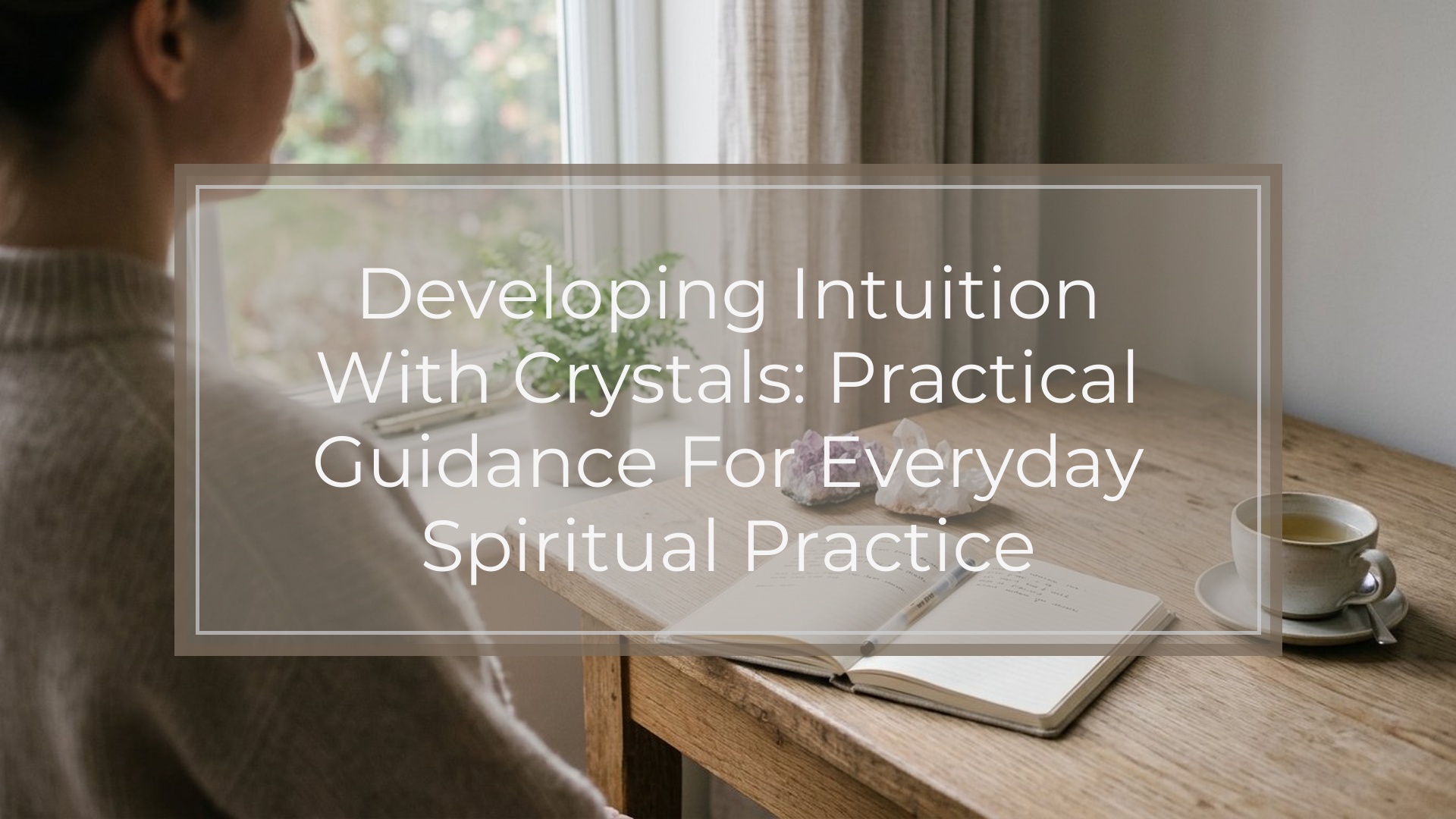
Developing intuition means learning to notice subtle inner signals—feelings, body cues, mental images, sudden clarity—and then testing them with honesty and consistency. Crystals do not need to be treated as magical shortcuts. Instead, they can work as supportive tools that help you slow down, focus attention, and build a repeatable spiritual practice.
For beginners, the most useful approach is simple: choose one crystal for a clear purpose, use it in a short daily routine, write down what you notice, and practice discernment. Intuition becomes stronger when you pair openness with observation. Crystals can support that process by giving your mind and energy a steady point of focus.
Quick Answer
If your goal is developing intuition, the main takeaway is this: crystals can support intuition best when they help you become calmer, more observant, and more consistent.
Intuition is often quieter than people expect. It may show up as a gentle sense of knowing, a physical yes-or-no feeling, a mental image, or a repeated nudge rather than a dramatic psychic event. Because of that, many beginners miss it or confuse it with fear, wishful thinking, or overthinking.
Crystals are useful here because they create structure. When you hold the same stone during reflection, meditation, journaling, or card pulls, you train your attention to settle. Over time, that makes it easier to tell the difference between noise and genuine inner guidance.
Beginner-friendly crystals for this work are usually amethyst, clear quartz, labradorite, moonstone, and sodalite. You do not need all of them. One crystal used consistently is more helpful than a large collection used randomly.
A grounded way to begin is:
- Pick one crystal with a simple intention.
- Sit quietly for five minutes each day.
- Ask one clear question.
- Notice body sensations, thoughts, and emotions.
- Write down what came up.
- Review later to see what felt accurate.
That combination—focus, repetition, and reflection—is what actually develops intuition.
How to Think About This Topic

A practical mental model is to think of intuition as a skill of perception, not a special performance. Developing intuition is less about trying to “receive a message” on command and more about becoming sensitive to patterns within yourself.
In that model, crystals play a supporting role. They are not replacing your judgment or making decisions for you. They act more like anchors for awareness. When you associate a crystal with listening inward, your nervous system starts to recognize that moment as a cue to slow down and pay attention.
This matters because most people are not lacking intuition—they are drowning it out. Stress, constant input, emotional charge, and mental chatter make subtle signals harder to notice. A crystal can help simplify the moment. It becomes a physical reminder: pause, breathe, listen.
For beginners, it helps to separate intuition from similar experiences:
- Intuition often feels quiet, clear, and simple.
- Fear feels urgent, contracted, and repetitive.
- Wishful thinking tends to say what you want to hear.
- Overanalysis keeps generating more and more arguments.
That does not mean intuition is always instantly obvious. It means you learn to recognize its tone over time. This is why journaling is so important. If you write down your impressions before the outcome is known, you can later compare what you sensed with what happened. That builds trust in real patterns instead of imagination alone.
It also helps to tie your practice to a specific intention. “I want to be more intuitive” is broad. “I want to notice my body’s yes-or-no responses” or “I want clearer insight during journaling” is more useful. The clearer the intention, the easier it is to choose a crystal and observe results.
Here is a simple way to think about common crystal roles:
- Amethyst: supports calm, spiritual focus, and inner stillness
- Clear quartz: supports clarity and amplifies your intention
- Labradorite: supports trust in inner guidance and transitions
- Moonstone: supports emotional intuition and receptive awareness
- Sodalite: supports clear thinking and honest self-observation
The keyword here is support. If you approach crystals as tools that help you practice presence and discernment, you are much more likely to have a healthy and useful experience than if you expect instant certainty.
Practical Guidance

The easiest way to start developing intuition with crystals is to use one short, repeatable routine. You do not need a complex altar, rare stones, or long meditations.
Choose One Crystal Based on Your Current Need
Use a crystal that matches the kind of intuitive support you want most right now.
- Choose amethyst if your mind feels busy and you want calm before insight.
- Choose clear quartz if you want simplicity and a neutral focus stone.
- Choose moonstone if your intuition feels connected to emotions, dreams, or cycles.
- Choose sodalite if you need help separating truth from mental noise.
- Choose labradorite if you are in a life transition and want to trust your inner sense.
If you feel drawn to more than one, pick the one that best fits your present situation rather than collecting several at once.
Use a Single Five-to-ten-minute Routine
Try this beginner routine daily for two weeks:
- Hold your crystal or place it in front of you.
- Take five slow breaths.
- Set one intention such as, “I am open to clear and grounded insight.”
- Ask one simple question. Examples: “What do I need to notice today?” or “Does this choice feel aligned?”
- Sit quietly for one to three minutes.
- Notice what appears first: a body sensation, image, word, mood, or sense of expansion or contraction.
- Write it down without editing.
- End by asking, “What practical action, if any, follows from this?”
This last step keeps your practice grounded. Intuition is most useful when it leads to wiser observation or action, not endless interpretation.
Test What You Receive
A common beginner mistake is assuming every strong feeling is intuitive truth. Instead, test your impressions.
For example, if you sense “wait before responding,” follow that advice in a small situation and observe the result. If you repeatedly get a calm sense around one option and anxiety around another, note it, but also check facts. Strong intuition and sound judgment work well together.
A helpful filter is:
- Does this insight feel calm rather than panicked?
- Is it simple rather than dramatic?
- Does it remain consistent when I revisit it later?
- Does it encourage clarity, honesty, or care?
If the answer is mostly yes, it may be worth trusting further.
Troubleshoot Common Issues
If you “feel nothing,” that does not mean the practice failed. It may mean your signals are subtle. Keep going and notice small things: posture changes, relief, hesitation, recurring thoughts, or dream themes.
If you keep changing crystals, simplify. Consistency helps you learn your own responses.
If you become dependent on the crystal, step back. The goal is not to outsource wisdom to a stone. The goal is to strengthen your relationship with your own inner guidance.
If your intuition seems to say different things on different days, consider your emotional state. Exhaustion, stress, and emotional activation can distort perception. Sometimes the most intuitive move is to rest, gather information, and wait.
Keep Your Expectations Realistic
Developing intuition usually looks like improved self-trust, clearer decision-making, stronger pattern recognition, and better emotional discernment. Those are meaningful results. You do not need dramatic visions for the practice to be real or valuable.
A crystal routine works best when it stays simple, honest, and consistent. Choose one stone, use one routine, observe your results, and let your understanding deepen naturally.
FAQ
What Should a Beginner Know First About Developing Intuition?
Start small and stay consistent. Intuition usually appears as subtle inner information, not dramatic messages. Use one crystal, one simple question, and one short daily practice. The goal is not instant certainty but stronger self-awareness, clearer patterns, and better discernment over time.
What Matters Most When Evaluating Developing Intuition?
What matters most is accuracy over time, not intensity in the moment. Notice whether your impressions are calm, repeatable, and useful. Journaling helps you compare what you sensed with what later happened, which builds trust in real intuition instead of guesswork.
What Mistakes Should Readers Avoid with Developing Intuition?
Avoid using too many crystals at once, expecting instant psychic results, or treating every emotion as intuitive truth. Also avoid letting crystals replace judgment. Intuition works best alongside grounding, reflection, and real-world observation. Simple routines usually teach more than constant experimentation.
What Is the Next Logical Step After Learning About Developing Intuition?
Choose one beginner-friendly crystal and follow a five-to-ten-minute routine for two weeks. Ask one clear question each day, write down what you notice, and review your notes at the end. That gives you direct experience, which is the best foundation for deeper practice.