
Have you ever wondered how those beautiful purple gemstones form deep beneath the Earth’s surface? Amethyst, a stunning variety of quartz, has captivated people for centuries with its rich purple hues.
Amethyst forms when silica-rich liquid fills cavities in volcanic rocks, allowing crystals to develop over time. This process happens during volcanic or hydrothermal activities deep within the Earth’s crust. The purple color that makes amethyst so special comes from iron impurities and exposure to natural radiation during formation.
You might be surprised to learn that amethyst can be found worldwide in various environments. It develops in igneous rocks, metamorphic rocks, hydrothermal veins, and hot springs. These purple treasures take thousands of years to form, which makes each amethyst crystal truly a gift from nature’s patient processes.
Formation of Amethyst
Amethyst forms through a fascinating natural process involving volcanic activity and specific mineral conditions. The beautiful purple crystals develop when the right elements come together under precise conditions.
Basic Components and Conditions
Amethyst begins its journey deep within the Earth’s crust during volcanic or hydrothermal activities. You might be surprised to learn that amethyst is actually a variety of quartz crystal.
The formation needs specific conditions to occur. Temperature plays a big role – amethyst typically forms at temperatures below 300°C. These cooler conditions allow the proper crystal structure to develop.
Pressure also matters in creating these purple gems. The right amount of pressure helps push the necessary minerals together to form the crystal structure.
Water is another key ingredient. Hot, mineral-rich water carries dissolved elements through rock formations. This water helps transport the building blocks needed for amethyst to grow.
Role of Silica and Iron
Silica is the main ingredient in amethyst formation. When you look at amethyst, you’re actually seeing silicon dioxide (SiO₂) – the same compound found in regular quartz.
Iron is what gives amethyst its famous purple color. Without iron impurities, the crystal would be clear like regular quartz. The purple intensity depends on how much iron is present and how it’s positioned in the crystal structure.
The iron must be in a specific oxidation state (Fe³⁺) to create the purple hue. Exposure to natural radiation helps convert iron to this state.
Other trace minerals can influence amethyst’s exact shade. Elements like manganese or titanium sometimes create unique color variations.
Process in Gas Cavities
Amethyst typically forms in hollow spaces called gas cavities or “geodes” within volcanic rock. These cavities form when gas bubbles get trapped in cooling lava.
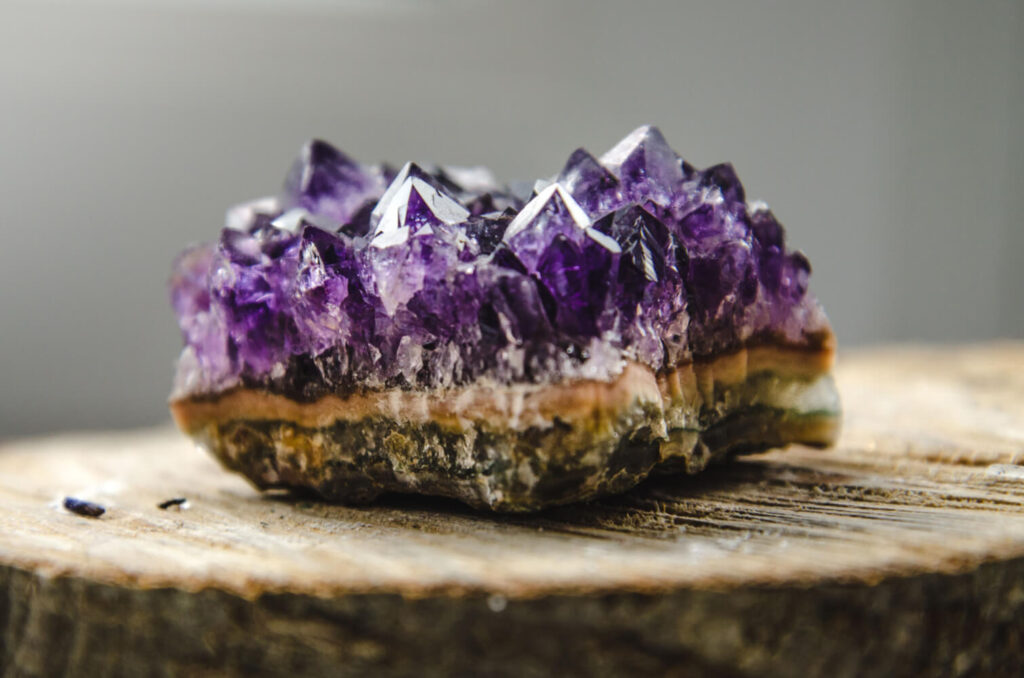
As silica-rich water flows through these spaces, it deposits minerals layer by layer. You can often see this layered growth pattern in amethyst geodes. The crystals grow from the outside walls inward.
The formation process is incredibly slow. Amethyst crystals might take thousands or even millions of years to reach their full size and color.
The best specimens often form where there’s plenty of space for the crystals to grow undisturbed. This is why many high-quality amethysts come from large geodes where the crystals had room to develop their distinctive pyramid-shaped points.
Characteristics of Amethyst Crystals
Amethyst crystals have several unique traits that make them special. They have a specific crystal structure, show different purple shades, and often contain tiny bubbles that tell us about how they formed.
Crystal Lattice Structure
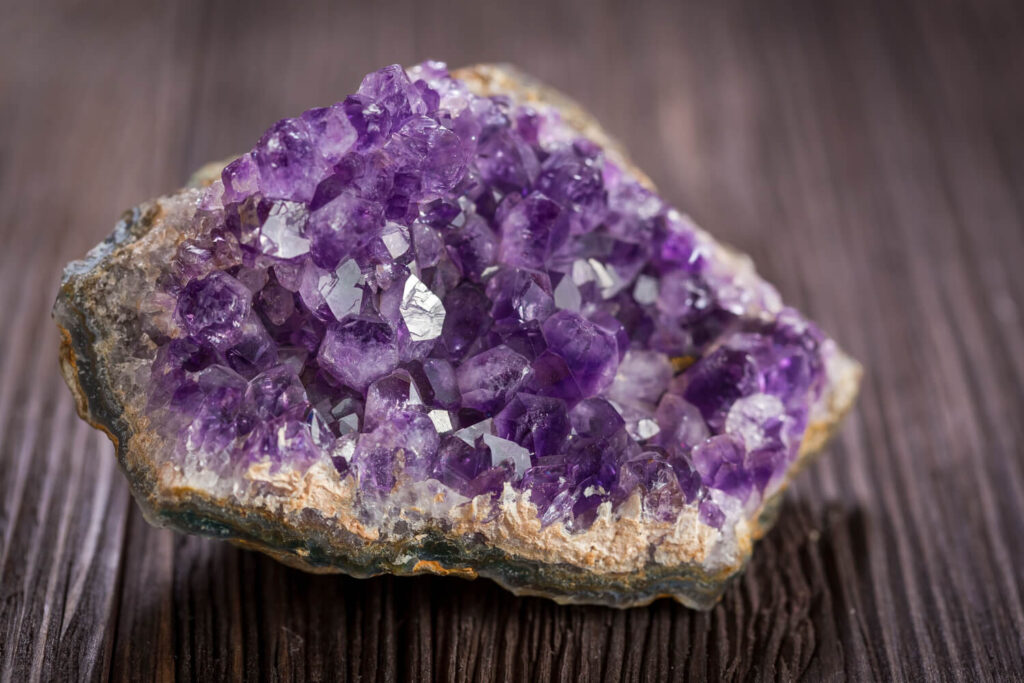
Amethyst belongs to the quartz family, which means it’s made of silicon dioxide. Your amethyst crystal has a hexagonal crystal system, giving it its classic six-sided shape. When you look at a natural amethyst, you’ll often notice a columnar form with a pyramid-shaped top called a termination.
The crystal lattice (the pattern of atoms) in amethyst is the same as clear quartz. Think of it as building blocks arranged in a specific pattern. This arrangement gives amethyst its hardness of 7 on the Mohs scale. This makes your amethyst durable enough for everyday wear in jewelry.
Amethyst crystals often grow in geodes – hollow rocks lined with crystals pointing inward. These form when the crystal lattice builds up layer by layer over thousands of years.
Color Variations
The beautiful purple color that makes your amethyst special comes from iron impurities and natural radiation. The shade can range from pale lilac to deep royal purple.
The color in amethyst isn’t usually even throughout the crystal. You might notice:
- Zoning: Bands or layers of different purple intensities
- Phantom crystals: Outlines of earlier growth stages visible inside
- Color gradients: Deeper color at the tips, fading toward the base
Heat can change amethyst’s color. If your amethyst is heated to about 878°F (470°C), it turns yellow-orange like citrine. Even natural sunlight can fade amethyst over time, so keep your precious stones out of direct sunlight.
Fluid Inclusions
When you look closely at your amethyst, you might see tiny bubbles or cloudy areas. These are fluid inclusions – small pockets of liquid trapped inside the crystal as it formed.
These inclusions tell geologists important information about the conditions when the crystal grew. They’re like time capsules from millions of years ago! Some common inclusions in amethyst:
- Water droplets
- Gas bubbles
- Tiny mineral crystals
- “Phantom” growth layers
Scientists use these inclusions to determine temperature and pressure during formation. Sometimes these inclusions create interesting visual effects like “enhydro” amethysts, which contain visible water bubbles that move when tilted.
The clarity of your amethyst depends on how many inclusions it has. Fewer inclusions generally mean a more valuable gemstone, though some collectors specifically seek out amethysts with unique inclusion patterns.
Global Sources of Amethyst
Amethyst, the beautiful purple variety of quartz, can be found in various locations across the globe. Each source produces stones with unique characteristics in color, clarity, and crystal formation.
Brazilian Amethyst Mines
Brazil stands as the world’s leading producer of amethyst. The states of Rio Grande do Sul, Minas Gerais, Bahia, and Maraba host the most productive mines. The Ametista do Sul region in Rio Grande do Sul is known as the “amethyst capital of the world.”
Brazilian amethysts often show deep purple colors with red flashes. Many form in geodes – hollow rock formations lined with crystals. Some Brazilian geodes reach impressive sizes – up to 10 feet tall!
Mining in Brazil began in the 1800s but expanded dramatically in the 1970s. Today, Brazilian mines supply much of the global market. The quality ranges from affordable specimens to collector-grade gems.
You might notice Brazilian amethysts have distinctive zoning patterns, with color bands showing varying intensities of purple.
The Riches of Uruguay
Just south of Brazil, Uruguay boasts some of the most spectacular amethyst formations in the world. The Artigas region near the Brazilian border is particularly famous for its amethyst production.
Uruguayan amethysts are known for their exceptional clarity and deep purple color. What makes them special is how they form in massive basalt rock cavities.
The mining operations here are often family-run businesses that have passed down techniques for generations. When you hold a Uruguayan amethyst, you’re likely holding a stone extracted using methods refined over decades.
These amethysts often form in what collectors call “cathedrals” – large geodes cut in half to display the crystal interior. Uruguayan specimens frequently appear in museums and private collections worldwide due to their extraordinary size and beauty.
Contributions of North America
North America offers several notable amethyst sources. Thunder Bay in Ontario, Canada, produces distinctive deep purple crystals with red undertones. These “Thunder Bay Amethysts” are prized by collectors for their unique color.
In the United States, you’ll find amethyst deposits in Arizona, Maine, North Carolina, and Colorado. The Four Peaks mine in Arizona yields highly sought-after deep purple gems sometimes called “Siberian amethyst” for their rich color.
Mining activities in North America tend to be smaller scale compared to South American operations. Many North American sites allow public collecting for a fee.
The Jackson’s Crossroads mine in Georgia has produced some spectacular specimens with an unusual blue-violet hue that collectors eagerly seek.
Other Notable Locations
Beyond the Americas, significant amethyst deposits exist worldwide. The Ural Mountains in Russia have historically produced exceptional deep purple specimens referred to as “Siberian amethyst,” setting the standard for top quality.
Germany’s Idar-Oberstein region became famous not for mining but for cutting and polishing amethysts. Today, you can visit museums showcasing their craftsmanship.
In Africa, Zambia and Namibia produce high-quality amethysts with rich, consistent coloring. African specimens often show fewer color zones than their Brazilian counterparts.
India, particularly the states of Maharashtra and Karnataka, yields beautiful specimens. Sri Lankan amethysts tend toward lighter lavender shades.
South Korea’s Chungyang mine produces an unusual green-tinged amethyst variety. Madagascar has emerged as an important source in recent decades, offering stones with exceptional clarity.
Geological Formations and Host Rocks
Amethyst forms in several distinct geological environments, each creating unique crystal characteristics. The purple quartz variety needs specific conditions to develop its signature color and structure.
Amethyst in Basalt
Basalt rock formations are the most common homes for beautiful amethyst geodes. These hollow spaces form when gas bubbles get trapped in cooling lava. Over time, silica-rich fluids seep into these cavities. Recent studies found that many amethyst geodes form at surprisingly low temperatures between 15-60°C.
You can find spectacular basalt-hosted amethyst deposits in Brazil, Uruguay, and Mexico. The famous Uruguay amethyst geodes can grow enormous—some large enough for you to stand inside! These formations typically show distinctive bands of growth, with deeper purple colors developing at the crystal tips.
The iron content in basalt helps create amethyst’s purple hue. When this iron oxidizes under the right conditions, it produces the signature violet to deep purple coloration you see in quality specimens.
Occurrence in Pegmatites
Pegmatites—coarse-grained igneous rocks—form another important environment for amethyst growth. These rocks develop from the final stages of magma crystallization when water and other elements become concentrated.
You’ll notice amethyst from pegmatites often has different characteristics than geode amethyst. These crystals are typically:
- Larger individual crystals (rather than geode clusters)
- More transparent
- Sometimes showing “phantom” growth patterns
- Associated with other minerals like feldspar and mica
Famous pegmatite amethyst locations include parts of Russia, Maine (USA), and certain African deposits. The crystals form as the mineral-rich fluids cool slowly, allowing for excellent crystal development and color zoning.
Other Volcanic Hosts
Beyond basalt, amethyst forms in various volcanic environments. You’ll find amethyst in:
- Rhyolite flows and volcanic breccias
- Hydrothermal veins cutting through volcanic rocks
- Ancient volcanic ash deposits altered by groundwater
These environments create different amethyst varieties. For example, the famous “Vera Cruz amethyst” from Mexico forms in gas pockets within rhyolite. These crystals often show distinctive “scepter” formations with a thicker crystal end growing on a thinner stem.
Groundwater moving through fractured volcanic rocks plays a crucial role in amethyst formation. As this water dissolves silica and other minerals, it creates the perfect solution for crystal growth when temperature and pressure conditions are right.
Types of Amethyst Deposits
Amethyst forms in several different types of deposits around the world. Each deposit type creates unique characteristics in the crystals that grow there.
Geode Deposits
Geodes are hollow rock formations that contain amethyst crystals inside. They form when gas bubbles get trapped in cooling lava. Over time, mineral-rich water seeps into these cavities.
The water carries silica and other minerals that slowly crystallize on the inner walls. This process can take thousands or even millions of years! The largest amethyst geodes come from Brazil and Uruguay, where some are big enough for a person to stand inside.
You can identify geode amethyst by its formation pattern. The crystals point inward from the walls of the cavity. The outer layer is often rough and unimpressive, hiding the purple beauty inside.
Druse and Chalcedony Associations
Druse formations occur when tiny amethyst crystals cover a rock surface. Think of it as a carpet of tiny crystals growing together. This creates a sparkling effect that’s popular in decorative pieces.
Amethyst often forms alongside chalcedony, a microcrystalline quartz variety. You’ll find these associations in volcanic rocks where silica-rich fluids have penetrated.
The combination creates interesting patterns and color variations. In some specimens, you can see layers where purple amethyst transitions into white or gray chalcedony.
These deposits are common in Mexico, Russia, and parts of Africa. Jewelry makers love these pieces because they often show beautiful color zoning.
Pegmatitic and Hydrothermal Sources
Hydrothermal veins form when hot, mineral-rich water flows through cracks in rocks. As this water cools, amethyst crystals grow along the walls of these fractures.
You can recognize hydrothermal amethyst by its long, prismatic crystals. These deposits often produce the deepest purple varieties that are highly valued.
Pegmatites are coarse-grained igneous rocks that form during the final stages of magma cooling. When conditions are right, amethyst can grow in pockets within these formations.
These deposits typically produce larger, clearer crystals than other sources. Famous pegmatitic amethyst deposits exist in Maine (USA), Ontario (Canada), and parts of Russia. The crystals from these sources often show fantastic clarity and color.
Amethyst in Jewelry and Gemstone Markets
Amethyst has been treasured in jewelry for centuries, prized for its rich purple hues and relative affordability compared to other gemstones. The gem’s versatility makes it perfect for various jewelry styles, from elegant evening pieces to casual everyday wear.
Amethyst as a Gemstone
In the gemstone market, amethyst is considered a semi-precious stone. Unlike diamonds or rubies, amethyst is more accessible to the average jewelry buyer. The color ranges from pale lilac to deep purple, with the most valuable specimens showing a rich, medium-dark purple hue with red and blue flashes.
When you’re shopping for amethyst jewelry, look for stones with good clarity and an even color distribution. The best pieces don’t have visible color zoning or too many inclusions.
Amethyst rates a 7 on the Mohs hardness scale, making it durable enough for daily wear in rings, pendants, and earrings. This durability, combined with its beauty, has made it a favorite for both costume and fine jewelry designs.
Cutting and Polishing Techniques
Jewelers cut amethyst in various ways to highlight its beautiful purple color. The most common cuts include:
- Oval and round brilliant cuts that maximize sparkle
- Emerald cuts that showcase color depth and clarity
- Fancy cuts like hearts, trillions, and cushions for unique pieces
- Cabochon cuts for a smooth, rounded appearance
Skilled lapidaries often orient the cut to take advantage of the crystal’s color zoning. This technique helps distribute the purple color evenly throughout the finished stone.
Polishing brings out amethyst’s natural luster. The gem takes an excellent polish, allowing light to play through the stone and enhance its natural beauty. Many artisans also create amethyst carvings and beads for more artistic jewelry pieces.
Market Demand and Value
You’ll find amethyst is one of the more affordable gemstones on the market. Prices vary based on color intensity, clarity, size, and cut quality. Deep purple specimens from Russia or Uruguay typically command higher prices than lighter varieties.
The global amethyst market has remained steady, with consistent demand for both raw crystals and finished jewelry. Brazil, Uruguay, Zambia, and Russia are the primary suppliers of high-quality amethyst.
Unlike diamonds, amethyst doesn’t have a standardized grading system. Instead, dealers classify stones based on:
- Color depth and saturation
- Clarity and transparency
- Size (carat weight)
- Quality of cut and polish
While not as expensive as precious gems, fine amethyst from premium locations can still command respectable prices, especially for large, flawless specimens with deep, rich color.
Metaphysical Properties and Cultural Significance
Amethyst has captivated humans for centuries with its striking purple hue and perceived special powers. Many cultures have developed unique beliefs about this beautiful gemstone and its effects on our minds, bodies, and spirits.
Ancient Beliefs and Uses
Ancient Greeks believed amethyst could prevent drunkenness – the word “amethyst” comes from the Greek “amethystos,” meaning “not intoxicated.” They often created drinking vessels from this purple quartz, hoping it would keep them sober during celebrations.
In Egyptian culture, amethyst was used in protective amulets and jewelry. The gemstone was associated with spiritual protection and clarity of thought.
Medieval European royalty prized amethyst as a symbol of power. They believed it encouraged self-control and piety. Catholic bishops wore amethyst rings as symbols of their connection to the divine.
In Buddhist and Hindu traditions, amethyst was connected to the third eye and crown chakras. People used it during meditation to enhance spiritual awareness and inner peace.
Modern Day Appeal
Today, many crystal enthusiasts value amethyst for its calming properties. You might find it helpful when seeking emotional balance during stressful times. The gemstone is often placed in homes to create peaceful environments.
Amethyst remains popular in meditation practices. You can hold it or place it nearby when meditating to help quiet your mind and deepen your practice.
Many people wear amethyst jewelry not just for its beauty but for its protective qualities. The gemstone is thought to create a shield against negative energies and enhance intuition.
In crystal healing, practitioners use amethyst to help with:
- Stress reduction
- Improved sleep
- Enhanced intuition
- Emotional healing
You’ll find amethyst in many modern spiritual shops, often recommended as a “beginner’s crystal” due to its gentle yet powerful energy.