
Making your own crystal pendulum is a fun and simple project that lets you create a personal tool for meditation and self-reflection. You only need two basic items to get started: a crystal or weighted object with a point, and a cord or chain to hang it from.
You can create a pendulum using any crystal, metal object, or even an old key – as long as it has some weight to it and comes to a point at one end. The pointed end helps you see clear directional movements when using your pendulum.
Your pendulum can be as simple or decorative as you like. Many people enjoy wrapping their chosen crystal in wire or adding beads to make it more beautiful. The most important thing is picking materials that feel right to you and putting them together in a way that creates a balanced, smoothly swinging tool.
Understanding Crystal Pendulums
Crystal pendulums serve as powerful tools for seeking guidance and connecting with your intuition. They work through the natural energies of crystals combined with the physics of movement.
The History of Pendulums
Ancient civilizations used pendulums for various purposes, from finding water sources to making important decisions. Egyptian builders used them to create perfectly straight lines for construction.
In the Middle Ages, miners began using pendulums to locate precious metals and gems underground. This practice became known as dowsing.
The use of crystal pendulums grew popular during the spiritual movements of the 1960s and 1970s. Many people started using them for personal guidance and healing work.
Types of Crystals Used in Pendulums
Popular Crystal Choices:
- Clear Quartz: Enhances clarity and amplifies energy
- Amethyst: Supports spiritual growth
- Rose Quartz: Connects to matters of the heart
- Citrine: Helps with decision-making
- Hematite: Offers grounding energy
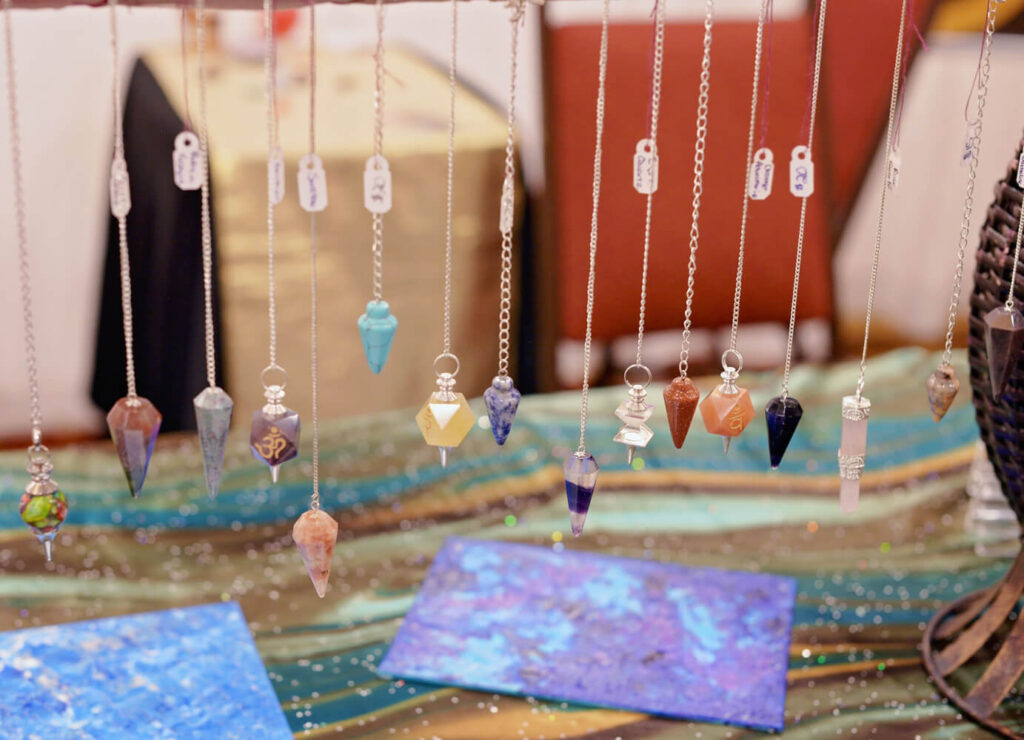
Your pendulum can be made from any crystal that feels right to you. The shape matters more than the type – it needs a pointed end to give clear directional movements.
The Significance of Different Crystal Properties
Each crystal brings unique properties to your pendulum work. Clear quartz acts as an amplifier, making it great for beginners.
Energy Properties:
- Red crystals (like garnet): Connect to physical matters
- Blue stones (like lapis lazuli): Aid communication
- Green varieties (like jade): Link to abundance and growth
The crystal’s weight affects how your pendulum moves. Heavier stones provide slower, more deliberate responses. Lighter crystals create quicker movements.
Pick a crystal that matches your purpose. If you want help with decisions, citrine works well. For emotional questions, try rose quartz.
Creating Your Crystal Pendulum
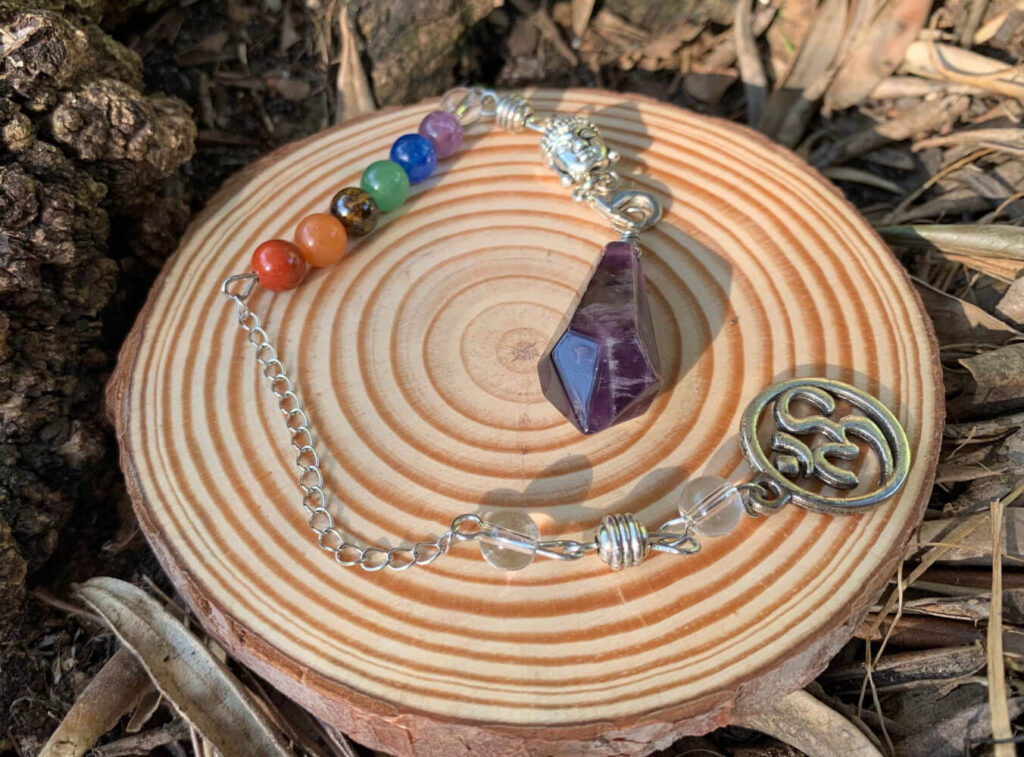
Making your own crystal pendulum lets you connect with the process and create something meaningful. The key steps involve picking the right crystal, gathering materials, preparing the crystal, and putting it all together.
Selecting the Right Crystal
Choose a crystal that speaks to you personally. Popular options include clear quartz, amethyst, and rose quartz. These crystals work well because they’re easy to find and naturally form in points.
The crystal should be about 1-2 inches long and have some weight to it. This helps create smooth, steady movements.
Pick a stone that feels comfortable in your hand. The shape can be natural or polished – both work equally well.
Gathering Your Materials
You’ll need:
- Your chosen crystal
- 6-8 inches of jewelry chain or sturdy string
- Jewelry wire (20-22 gauge)
- Wire cutters
- Needle-nose pliers
- Optional: small decorative beads
Make sure your chain or string is strong enough to hold your crystal without breaking. Metal chains tend to last longer than string.
Shaping and Attaching Your Crystal
Start by wrapping your crystal with wire. Leave a small loop at the top for attaching the chain.
Make 3-4 tight wraps around the widest part of your crystal. This creates a secure base.
The wire should feel snug but not so tight that it might crack your crystal. Twist the remaining wire into a loop at the top.
Assembling the Pendulum Chain
Attach your chain or string to the wire loop you created. If using string, double-knot it for extra security.
The ideal length for your pendulum is about 6 inches from top to bottom. This gives you good control during use.
Add a small bead at the top of the chain as a holding point. This makes it easier to grip your pendulum.
Test the movement by holding it still and letting it swing naturally. The crystal should move smoothly without spinning or jerking.
Using Your Crystal Pendulum
A crystal pendulum helps you get clear answers through simple movements. The key is to prepare your pendulum properly, hold it correctly, and learn what different swings mean.
Purifying and Charging Your Pendulum
Clean your pendulum with running water or sage smoke to remove unwanted energies. Pat it dry with a soft cloth.
Place it in direct moonlight or sunlight for 4-8 hours to charge its energy. Some people like to leave it overnight during a full moon.
You can also charge your pendulum by placing it on a clear quartz cluster for a few hours. The crystal will amplify your pendulum’s energy.
Holding and Using Your Pendulum
Hold the chain or string about 6-8 inches from the crystal. Keep your elbow steady against your side.
Let the pendulum hang freely without touching anything. Stay relaxed and breathe naturally.
Ask simple yes/no questions out loud or in your mind. Keep your questions clear and specific.
Wait patiently for the pendulum to move on its own. Don’t try to force any movement.
Interpreting Pendulum Movements
Common pendulum signals:
- Back and forth (like nodding): Usually means “yes”
- Side to side (like head shaking): Usually means “no”
- Clockwise circles: Often means “positive” or “affirmative”
- Counterclockwise circles: May indicate “negative” or “no”
Test these movements by asking your pendulum to show you “yes” and “no.” Write down what movements you get.
Practice with simple questions you already know the answers to. This helps you learn your pendulum’s unique way of communicating with you.